viernes, noviembre 30, 2007

India 2.0

En ZDNet (UK), Adrian Bridgwater escribe sobre la creciente evolución india del outsourcing a innovador tecnológico. Pasada una fase inicial de oferta de trabajo de bajo valor, no sólo despuntan grandes competidores en mercados de desarrollo de software para mercados específicos o consultoría, sino que India trata de lograr un lugar en primera línea, innovando. Bridgwater habla de un cambio fundamental:
(...) "Innovation was always there, but the right conditions, ecosystem and critical mass did not exist from 1947 until the early 1990s. Now, venture capitalists are more willing to venture forth in emerging markets and back entrepreneurs — and India's universities have helped create critical mass in terms of skilled workers. So, as these factors start to coalesce, innovation and entrepreneurship are now much more evident in many different parts of India," said Kamla Bhatt, acclaimed Indian podcaster and presenter of The Kamla Bhatt Show.
(...) PricewaterhouseCoopers estimates that India has roughly two thirds of the global business-process outsourcing (BPO) market, with a value in excess of $7bn (£3.4bn) last year. However, it appears the country has ambitions beyond outsourcing; the Indian technology sector seems to be changing as it develops a new self-belief. Google's labs in Bangalore conceived the initial engineering for the company's Google Finance offering in less than 18 months. This type of development has created the momentum for venture capitalists to propel further developments and invest in an increasingly skilled workforce.
Un aspecto clave, el acento puesto de manera continuada en la formación de profesionales calificados en nuevas tecnologías:
The Indian Institute of Technology is widely regarded as the sub-continent's premier technology school; its seven locations churn out many of the ultra-keen software engineers that are starting to make headlines. Commentators claim there are visible signs that a shift towards higher-value work is occurring.
(...) "BEA has seen its training volumes in India rise from hundreds to thousands of students a year. Big systems-integration firms in many of India's industrialised cities now demand tailored courses and even train over the web, live linked to instructors in the US. The latest trend is for these SIs to become authorised trainers in their own right, so they can train in BEA's technologies to their own timetable in-house," said David Toso, senior vice president of BEA EMEA services.
(...) "India is certainly witnessing a secondary stage in the economic growth it derives from its technology sector, as it channels its workforce towards home-grown projects targeted at a global market," said Bruce Carney, head of developer programmes and services for Symbian. "In the past month, two leading Indian universities have joined our Academy programme and this type of knowledge-base expansion has created the momentum for venture capitalists to propel further developments and invest in an increasingly skilled workforce."
Bridgwater menciona General Motors como uno de los casos de mayor acento en el desarrollo innovativo:
"We are starting to see the creation of technology as a direct revenue generator — not merely as an enabler for making some service delivery faster, better or cheaper. Much of this is still driven by global organisations that originally set up captives to exploit the cost advantages of the Indian skills market, but [which] have graduated to becoming a strategic part of the global technology-development capability of these organisations — truly contributing to the creation of their products and technologies, including product management. For example General Motors R&D in India is developing next-generation electronics and materials for cars of the future," added Stones.
No hay duda que India logrará un lugar de importancia en base a su esfuerzo. Como otros casos, demuestra que es posible crecer aunque se haya partido desde posiciones de menor valor económico. Se trata de entender cómo...

domingo, noviembre 25, 2007

Software Factories: Definición redefinida

En estos días estoy reescribiendo, en cualquier hueco de tiempo, algunos conceptos de La Cuarta Generación que son obsoletos o poco claros. Entrando en ello, veo que Jezz Santos, en Octubre de este año, escribe un utilísimo artículo explicando el alcance de las factorías de software en versión Microsoft, que ponen las cosas en su lugar. Lo adelanto, y espero poder volver sobre el tema, aquí y en "La Cuarta...".
Quiero destacar una llana confesión de Jezz:
Although a software factory sounds like a new type of development tool which may have its own integrated development environment (IDE), in actual fact, Microsoft software factories are intended to extend and configure the general IDE of Visual Studio .NET.
Ahora, si volviera sobre toda la hojarasca teórica acerca del UML y las servilletas de papel, creo que al menos podríamos decir que en esa discusión hay al menos un problema de descoordinación de dominio: Jezz está hablando de una extensión a un ambiente de desarrollo dedicado a un marco específico, .NET, y UML está en un nivel de generalización teórica superior.
Un poco más de Jezz:
First and foremost a software factory is a software development tool. Built by developers, primarily for developers, architects, and others roles in the software development life cycle, such as designers, testers, business analysts project managers. This ‘tool’ is used to manage and automate the assembly and/or configuration of a software solution that addresses a well-known, specific business/problem domain, and is primarily used to create an executable solution from that.
How does a software factory differ from other general development tools and technologies we use today, such as C#, VB, and Visual Studio? A software factory is a specific domain focused tool, with a specific set of instructions, targeted at solving a small specific business/problem domain. Whereas, a general development tool like C# or VB is used to build basically anything we want (within limits of course) it’s a relatively unspecific tool, used to solve any business/problem domain. The point here is that a general development tool can be used to build anything, and therefore it’s left to you to manage the bounds of creating that thing (it is boundless). A software factory, through the use of a software factory schema, tooling and a managed runtime actually instructs and guides you through a known process for building the thing it knows how to build. It is very much constrained to the domain it was designed to address, and not much more.
(...)
This idea is really nothing new today in the Visual Studio IDE where we already use many existing abstractions to increase productivity in developing solutions: the Windows Forms Designer, Windows Workflow activity diagrams, XML schema editors, SQL, configuration files, among many others. What is new though, is providing custom dedicated abstractions tailored specifically to the product or solution we want to help build.
Volveremos sobre ésto. El artículo de Jezz es de real interés.

viernes, noviembre 23, 2007

Las mayores empresas de software europeo

Lo acabo de encontrar en el blog de Juan Palacio: el ranking de las primeras cien empresas de software de Europa. Si a Juan le apena no encontrar allí empresas españolas, a mí me sorprende. Hubiera pensado que al menos alguna de las conocidas daba la talla para entrar allí. Con tiempo revisaré los números. Quizá dependan de cómo se desagreguen. ¿ninguna que alcance los 20 millones de euros?. Buscando un poco, quizá las cifras de Meta4 (es española hoy?)...; Indra factura servicios...¿Panda?, no sé. Sin embargo, las cifras parecen bajas. Una nota que busca cifras, no pasa de cinco millones. Es cierto que lo que conozco es en general gestión de servicios, manejo de recursos humanos, pero no mucho desarrollo de algún tipo de software. Sin embargo, también muchas pequeñas empresas innovadoras, incluyendo el área que me interesa, generadores de código. Mucho para pensar, aunque otros deben ser quienes lo hagan.

domingo, noviembre 18, 2007

Adios a ASC

Esto es más un recuerdo personal que una noticia de importancia. Leyendo en System I Network, encontré una publicidad sobre Abstract que no venía de ASC, sino de Help/Systems. Leyéndola, encontré al menos también a SEQUEL, por lo que entendí que ASC había sido comprada, o había vendido sus líneas de producto. Tuve que buscar un poco hasta encontrar la noticia de su venta durante octubre de 2006. ASC fue una de las líneas de producto que la empresa en que trabajaba representaba hasta su desaparición. La crisis económica argentina se llevó a Oryon, y probablemente el cambio global de los negocios se ha llevado a ASC. ASC representaba un modelo de negocios que parece que fue arrasado en un momento: una pequeña empresa dedicada a un nicho de mercado, los utilitarios de AS/400 (perdón, ISeries, System I, o el próximo nombre que se le dé). Unos productos que alcanzaron su lugar, y que se hicieron un nombre (Abstract fue muy útil para analizar problemas en la crisis del año 2000, SEQUEL sigue siendo una vía guiada poderosa para consultas tipo SQL). El fin de la burbuja en Estados Unidos implicó una concentración de empresas en menos manos que todavía no ha cesado. En su caso, tres elementos seguramente participaron de su fin: estar en un solo mercado, seguir el modelo de precios de IBM, y, como consecuencia del primero, no tener alternativas ante una declinación del mercado del ISeries. ¿Será así? Quizá pueda averiguar algo de primera mano en algún momento. ¿ISeries en declinación? Al menos, no participando del mercado de la manera que pudiera. ¿Sabe qué hacer IBM con el producto? Muchos se preguntan ésto, pero este es otro asunto.

lunes, noviembre 12, 2007

Cognos será azul

EbizQ informa que IBM se propone comprar Cognos, una de las últimas grandes empresas dedicadas a Business Intelligence, por un precio aproximado de 4.900 millones de dólares. Luego de Hyperion y Business Objects, casi todos los competidores del negocio pasan a ser parte de grandes operadores corporativos: Oracle, SAP, IBM. La noticia en EbizQ:

Today IBM announced its intention to acquire Cognos in an all-cash transaction at a price of approximately $5 billion USD or $58 USD per share, with a net transaction value of $4.9 billion USD. The acquisition is subject to Cognos shareholder approval, regulatory approvals and other customary closing conditions, and is expected to close in the first quarter of 2008.
Steve Mills introduced the analyst briefing by talking about the state of the market, with companies becoming more sophisticated about leveraging information, and using analytics for both looking back, and looking forward, becoming more pre-emptive in their decision making. He also spoke about how real-time business analytics was becoming an important part of business process management.
Just about every analyst on the call would have to agree with those statements. Last June, in the ebizQ BI in Action virtual conference this was discussed extensively both in the panel session and in a series of pre-conference podcasts. Indeed, one of the analysts questions was that we’ve been expecting this for a while, why now (answer – a $5 billion purchase takes time).
Cognos fits very well into the IBM stack. For a change it pretty much adds new functionality without adding a lot of redundancy. Furthermore, about 5 years ago Cognos re-architected their solution as a service based offering. It runs on top of IBM (and other) infrastructure software, providing real-time business intelligence and business performance management. The business performance management capabilities are key It enables companies to align, monitor and measure business operations with business strategies. This is truly good stuff – very important to business managers.

Como refiere el artículo de Beth Gold-Bernstein, la visión de IBM es muy optimista:
"Customers are demanding complete solutions, not piece parts, to enable real-time decision making," said Steve Mills, senior vice president and group executive, IBM Software Group. "IBM has been providing Business Intelligence solutions for decades. Our broad set of capabilities – from data warehousing to information integration and analytics – together with Cognos, position us well for the changing Business Intelligence and Performance Management industry. We chose Cognos because of its industry-leading technology that is based on open standards, which complements IBM's Service Oriented Architecture strategy."
(...) “This is an exciting combination for our customers, partners, and employees. It provides us with the ability to expand our vision as the leading BI and Performance Management provider,” said Rob Ashe, president and chief executive officer, Cognos. “IBM is a perfect complement to our strategy, with minimal overlap in products, a broad range of technology synergies, and the resources, reach, and world-class services to accelerate this vision. Furthermore, this combination allows Cognos customers to leverage a broader set of solutions from IBM to advance their information management driven initiatives.”
Me olvido de alguna? Sólo queda Informatica Corporation, entre las grandes. El negocio de ERP e inteligencia de negocios cada vez más concentrado.

domingo, noviembre 11, 2007

Steven Kelly nuevamente sobre Software Factories

Durante el mes de octubre, Steven Kelly publicó un par de notas en su blog que comparto en más de un aspecto. De una ya hemos hablado; la otra fue motivada por un artículo de Jack Greenfield en Methods & Tools, y retoma la discusión iniciada comentando a Jezz Santos: qué es primero, el problema o la solución.
El artículo de Greenfield es más explicativo que otros sobre su esquema, aporta algunos elementos de interés, pero también refuerza las dudas sobre el valor de su iniciativa. Pensaba pormenorizar algunos de sus conceptos, pero Kelly lo hace con claridad. Recomiendo leer su opinión, siguiendo el conjunto de la discusión, que incorpora referencias a Jezz Santos y Juha-Pekka, que completan la idea.
Jack does hint at more specialized factories than the earlier very generic "horizontal" factories he has tended to talk about. But the level of abstraction is not being raised much above how people currently code:
Known good patterns and practices in the target domain are harvested, refined and encoded into domain specific tools and runtimes. The tools are then used to rapidly select, adapt, configure, complete, assemble and generate solutions that use the runtimes.

Let's do a thought experiment. Imagine yourself back in time to when applications were built with assembly language. Which of the words that I've italicized above would indicate a radical shift upwards in the level of abstraction? E.g. if you can select among some existing chunks of assembly language -- nice maybe, but you're still working on the same level: you've not moved to third generation languages yet. Only the final verb, generate, accomplishes that change.

In the same way, insofar as Jack's article is a good description of Software Factories, it looks like their emphasis is more on small percentage improvements of existing ways of building software. That's a shame, especially given that earlier they seemed more focused on the DSL and generation elements that they share with Domain-Specific Modeling. The $64,000 question is: why this change of emphasis? Jack, Jezz, Prashant Sridharan and other MS people have all made comments along the lines that doing real problem-domain-based DSM has proven too hard for them. Why are they failing, when so many others are succeeding? For examples of success, just take a look at the articles from the upcoming 7th OOPSLA workshop on Domain-Specific Modeling (e.g. 24, 14 and 10 are all graphical DSL examples).

jueves, noviembre 08, 2007

La red en el futuro

Que la creciente importancia de la web está cambiando ampliamente la construcción y utilización del software, es indudable. Cambian arquitecturas, posibilidades, instrumentos, recursos, y participantes. El grupo de tecnología de Wharton comenta uno de los aspectos que prefiguran claramente cambios en la ubicuidad y movilidad del uso del software: la integración de las aplicaciones de escritorio y la web. En su artículo sin firma, Wharton balancea a los principales contendientes y los distintos puntos de vista para lograr este objetivo, y también juega una opinión.
On October 1, Adobe Systems announced an agreement to buy Virtual Ubiquity, a company that has created a web-based word processor built on Adobe's next generation software development platform. One day earlier, Microsoft outlined its plans for Microsoft Office Live Workspace, a service that will combine Microsoft Office and web capabilitiesso that documents can be shared online. Recently,Google introduced a technology called "Gears" that allows developers to create web applications that can also work offline. The common thread between the recent moves of these technology titans: Each company is placing a bet on a new vision of software's future, one which combines the features of web-based applications with desktop software to create a hybrid model that may offer the best of both worlds.
Wharton ve dos estilos, uno que viene de una historia basada en el escritorio, y otra que nació en la Web, de tal forma que el acento está puesto en la red o en la estación local (desktop/Webtop). Su idea es que ninguno de los dos es suficiente:
But as this drive toward hybrid desktop/webtop software illustrates, there are limits to both approaches, and the future for software may be a blend of the best features of both.
(...) The most likely outcome is a hybrid future where desktop and web-based software and services become intertwined to the point where users won't know the difference between the two, suggest experts at Wharton and elsewhere. "We believe that the future of technology at work will be a combination of local software on PCs, along with services," said Jeff Raikes, president of Microsoft's Business Division, in a question and answer session at the announcement of Office Live Workspace on September 30. "Think of it as a continuum, ranging from pure software to pure services approaches. Most customers will be somewhere in the middle."
Los profesores Eric Clemons y Kartik Hosanagar, apunta a los aspectos más diferenciadores de esta tendencia:
(...) this model is likely to develop in two phases. "In the first phase, applications will provide essentially the same features as a desktop application, only you will now be able to access them from anywhere. Current web-based apps are good examples of this." For example, Yahoo Mail looks a lot like Microsoft's Outlook email program. Google Docs and Adobe's Buzzword mimic Microsoft Word and add perks like the ability to access your documents from any computer.
In this phase, occurring today, Hosanagar says desktop applications will offer more features than web-based software, but over time that advantage will erode.
In the second phase of this hybrid model, web applications and desktop software will co-mingle, says Hosanagar. "What's likely to be more exciting is the next phase, where these web-based applications can interact and share data with each other and become platforms [that developers can use to build more software]. Facebook has already become one such platform, as has Salesforce.com on the enterprise side. In the next phase, far more interesting things will happen as these web apps start talking to each other."
Clemons notes that another critical factor for the evolution of software will be mobile applications. "My bet is that desktop software will be used for home operations, and webtop software will be used for mobile applications," says Clemons. The key will be synchronizing desktop and web software wherever a person goes. "None of us has a good idea what these mobile applications will be, but they may provide real value."
Krishnan Anand agrega otro elemento, "pay-per-use":
Anand says another model that's likely to emerge is one that is based on usage. In this model, a person who used a program infrequently could employ the web-based version for free or a small fee. Heavy users would pay more based on usage. In this model, which would apply to both web-based and desktop software, Anand likens software providers to electric utilities. "The notion is you can charge different prices based on levels of usage," he says.
Sin embargo, la confiabilidad sigue siendo débil:
"Reliability is critical for many of us. Even now, networks crash and I can't access files. I still have to make sure I have a copy on desktop. Until that changes, I don't see an advantage to web-based applications."

domingo, noviembre 04, 2007

Un poco de humor para analizar la Web


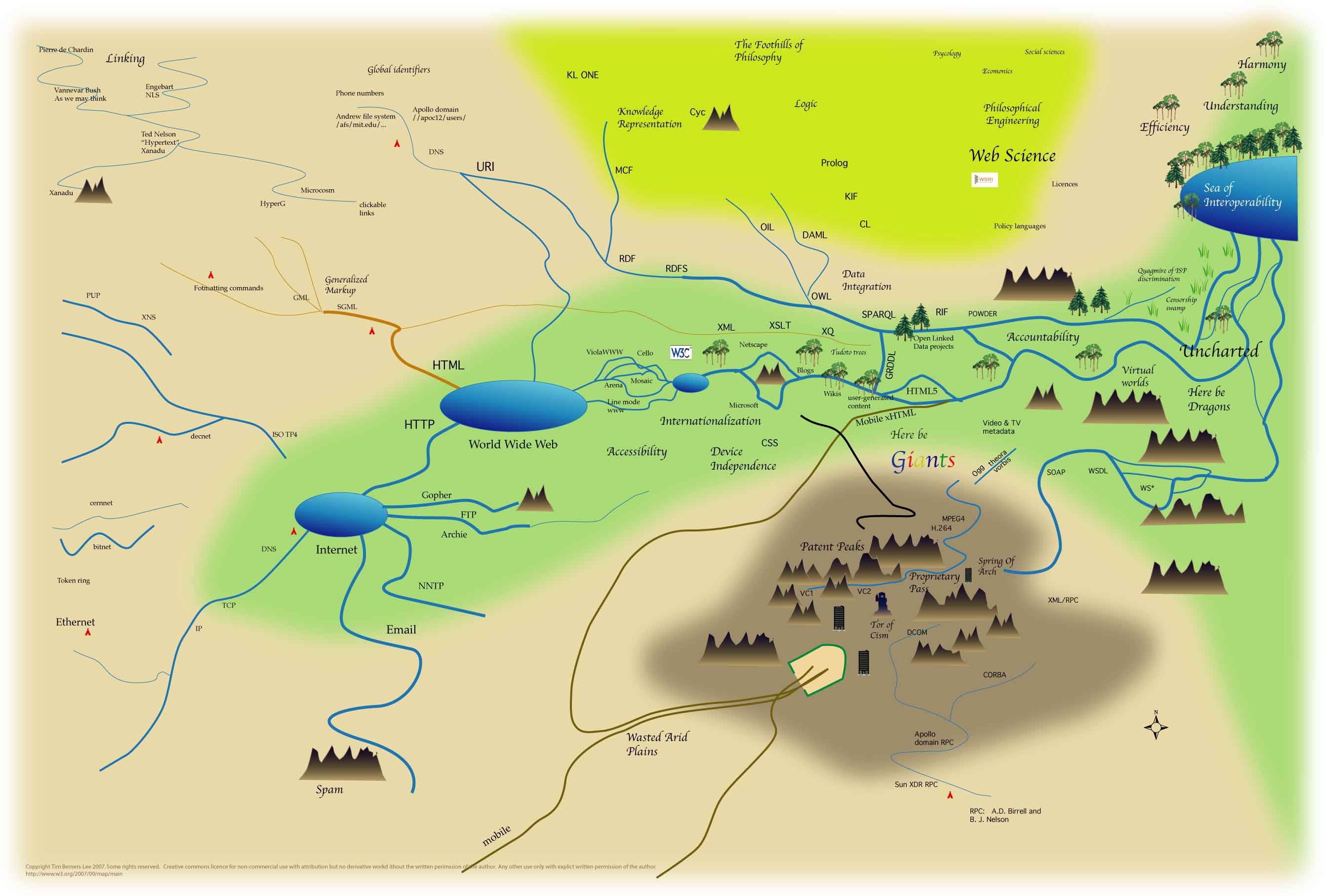
InfoQ publica una pequeña nota sobre el trabajo de Paul Downey, quien creó un mapa de la web combinando algo de su historia, sus estándares y otras relaciones, como si fuera el mapa de la Tierra Media del Señor de los Anillos. Siguiendo la nota, aparece otro intento similar, comentado por Amivdh, alojado en W3C. Arriba, los dos "mapas".
La nota de InfoQ:
Paul Downey from BT has produced an adventuring map for the Web in the style of that used by the Fellowship of the Ring, or Bilbo. It includes historical aspects, relationships to standards and other wonderful visualizations. Using a Web 2.0 approach, the original map is augmented with various call-outs to emphasize different aspects, such as "Google's all seeing eye", Mordorsoft and "FUD" in what would be Mordor, the Tower of WS-Babel, which is surrounded by the Swamp of BPEL and the Ruins of CORBA. Although probably starting out as a fun way to visualize the world of SOA, Web Services and the Web in general, it makes some interesting points (such as the reference to the Maelstrom of Incompatibility and the Lost Tribe of UDDI).

Downey dejó disponible un detallado pdf sobre su mapa. El sitio en Flickr también permite un recorrido detallado de cada parte del mapa, en fotografías sucesivas.

miércoles, octubre 31, 2007

Google a 700 dólares por acción

Con una subida de 723% por acción desde su lanzamiento, Google ha resultado una inversión fabulosa para quienes la compraran y la mantuvieran desde temprano en su historia. ¿Una burbuja o un negocio real? Las noticias que causaron su último salto hacia arriba pueden dar la respuesta: Firmes intentos de unir su software con la telefonía, próximo lanzamiento de su sistema operativo, y una batería de nuevas áreas de negocios apoyadas en la apuesta por la interactividad y las redes:
En Clarín:
Los títulos se dispararon luego de que se supiera que está en negociaciones con Verizon Wireless y Sprint y que quiere competir con las redes sociales Facebook y MySpace. En lo que va del año, las acciones han ganado un 52%.
Las acciones del Google superaron hoy en el mercado del Nasdaq en Nueva York los 700 dólares por título, después de saberse que está en negociaciones con Verizon Wireless y Sprint y que quiere competir con las redes sociales Facebook y MySpace.
Las acciones de Google llegaron a tocar los 701,47 dólares y a la media hora de la apertura del Nasdaq subían 4,68 dólares (un 0,67 por ciento) hasta los 699,45 dólares por título.
Los inversores compraban acciones de la compañía tras conocerse que dentro de dos semanas se espera que anuncie un nuevo software y servicios para que los fabricantes de teléfonos móviles pueden adaptarlos al sistema operativo de Google, que está previsto que salga al mercado en 2008. Las acciones de Google han subido un 52 por ciento en lo que va de año y un 723 por ciento desde que en agosto de 2004 empezó a cotizar en el Nasdaq.

domingo, octubre 28, 2007

Ricardo Galli cambia de servidor

Ricardo Galli, a quien sigo con mucho interés desde hace menos tiempo del que debiera, cambió el sitio de soporte de su blog. En medio de una polémica que afecta a cualquiera que haya utilizado un blog, lo retira del dominio de su universidad. Si usted lo seguía, agende su nueva dirección. Por mi parte, lo agregaré en mi lista lateral.

sábado, octubre 27, 2007

Telefonía móvil en Argentina

Carlos Slim, que de este tema algo conoce, sostiene que la densidad de teléfonos móviles en Argentina es la mayor de América:
"La telefonía celular atraviesa una situación formidable. Argentina ya tiene mayor penetración de móviles sobre la cantidad de hogares que los EEUU", afirmó el multimillonario Carlos Slim, considerado el hombre más rico del mundo y uno de los mayores empresarios de las telecomunicaciones a nivel mundial.
"Más del 90% de la población tiene celular y es el número más alto de toda América, expresó el magnate mexicano al matutino porteño Clarín.
La empresa de telecomunicaciones Telmex, propiedad del mexicano, anunció que invertirá u$s2.430 millones en 2008. La inversión se destinará a fortalecer la infraestructura, reforzar la banda ancha y desarrollar proyectos.
La cantidad económica que la empresa prevé invertir el próximo año, representa un 28% más de lo estimado para 2007.
La empresa informó que de esa suma de dinero, invertirá u$s1.100 millones en México, u$s700 millones en Brasil, u$s300 millones en Colombia, u$s60 millones en la Argentina, u$s70 millones en Ecuador, u$s100 millones para Perú y una cifra similar para Chile.
En todo caso, el elogio no se corresponde con la importancia relativa de su inversión...
Citado en Infobae, tomado de una reunión empresaria en Uruguay.

miércoles, octubre 24, 2007

Web y negocios: Estrategias erróneas

Un comentario de John Ghrist sobre su experiencia en la consulta de sitios corporativos, enumera varios casos típicos que cualquiera que busque información comercial puede encontrar. Algunos de estos tipos podemos verlos a nuestro alrededor, y alguno puede requerir "mención especial" en un reparto de premios. De lo que describe, creo que podemos separar dos clases de problemas: los que caen en la esfera de una débil estrategia de captación de negocios, y los que tienen que ver con el (mal) servicio de atención al cliente.
Ghrist en su idioma:
I have a gripe, and I'm wondering how many people out there share it with me. My gripe is that there are a surprising number of product vendor websites that make it illogically difficult to get information from those sites about the products their companies offer.
I've never actually confronted a vendor about this, and I don't mean to imply all the violators are in our market -- they're not. I'm not going to name names, either. But if any of what follows strikes a distant chord with you, whether you're a software vendor or not, take a look at your own website and see if your company might not be guilty of at least one, if not a few, of these sins.
Ghrist usa una hipotética búsqueda de producto (un software que cree estadísticas para la temporada de baseball):
let's say you're the IT manager of a company that wants to offer fantasy baseball leagues to the public next season. You've got a shiny new 525, and you need a piece of software to run on it that compiles baseball statistics and lets users rank players based on any given statistic, for starters. Other features would be gravy, maybe gravy worth having, but it depends on what they are. But you don't want to talk to a salesperson yet. You want to get a feel for what's out there, what features are pretty standard in the available products, what special options only one or two packages might offer, what a general ballpark (pun intended, blush) price might be. After all, when you actually do call a salesperson, you certainly don't want to sound like you're some ignorant mark who's calling a salesperson of baseball statistics software for the first time, do you? So off you go on a search of baseball statistics application vendors' websites.)
Los tipos de estrategia:
Ninguna información, sólo generalidades
The first kind of website you find is what I'd call the "it's all about the marketese" website. It's the kind of place where you can't find any product information except vague generalities. These sites have tabs you can click to be directed to "product information," but when you get there, what you find is less than helpful.
Algo de información, pero falta de contexto:
The second kind of website I'd call the "deeper mystery" website. It's more normal looking. It has some docs that actually describe some product features. That's helpful. It may even have white papers or a case study or two that describe the software in action or show an actual example of what it did for some company. More helpful. OK, so you're ready to put them on your short list. Oh, but does the software run on the System i? Ahhh, now they have you. After searching every document you can access, you can't even find verification that it runs on a Windows PC! It must run on Everycomputer, that mysterious machine that so many marketing departments seem to assume that all companies have, so why should they bother with niggling little details like the supported platform or OS? And what version of i5/OS does it support? Are you kidding?
Información se consigue, pero primero lo ataremos bien:
This one lists its products, each with a one- or two-sentence description that tells you "for sure, this is a baseball statistics software vendor all right," but not much more. But there's the promise of much more here. The site says it offers all sorts of information: testimonials, reviews, charts comparing (unfavorably, of course) competing products to this vendor's wonderful offering, maybe even some actual user docs. But there's one little catch. To access any of it, you have to fill out a long demographics form in which you identify yourself, your company, your phone number, your e-mail address, your company's gross income, your annual IT budget, how much you're willing to spend on baseball statistics software. . . and you're not allowed to submit the form if so much as one field is left blank. It's about everything you don't want to get into right now. And if you should bite like the good little fishie they hope you are, don't be going down the hall for the rest of the day because sales people will be calling momentarily.
El sitio fantasma, sin detalles, sin información de productos o de la empresa:
This is the kind of website that has a few static pages that describe the business, but not necessarily any products. (Except for one product, unnamed, about which there's someone expositing on the tweak the company made to some piece of code buried somewhere in the product, which the vendor is offering as a public gesture towards openness, but comments in the code date it to early 1999.) There are testimonials about the enterprise, but virtually nothing about offerings. If you want that classified information, you have to fill out one of those anonymous request forms that are automatically e-mailed to "info@anycompany.com" (but at which the intern responsible for checking this e-mail account was laid off two months ago, and this was one duty no one thought to reassign). There's no clue about where this company might be located. There's maybe not even a phone number. You have to contact them their way or not at all.
La super-corporación que tiene todo, pero atiende en un número comercial, que nunca da lo que se espera:
It's a megacorporation! It must have what you need. Oh, boy, look at all that statistics software! Five different packages, 50 different options. A GUI in Farsi for the Middle Eastern customers! You've got it made! Just call the 800 number. Oh, but . . . all available operators are busy. And when you do get through, the connection is dropping out, you have to repeat your request twice. "I'll transfer you." A phone ring, changing to another kind of phone ring, after five rings changing to a third kind. The guy who answers has an Indian accent, and there are pauses between what the two of you say while the satellite relays your words. "Sells department? You want sells? I'll transfer you," and you immediately get the "busy-circuit signal." You're punted, go back to start.
Este último caso lo vivo frecuentemente...Ya mencioné antes ONO (1)y APP. Aquí se habla de la preventa, lo que es peor, porque una mala atención al tratar de comprar, preanuncia un comportamiento similar (seguramente peor), una vez que el "cliente" está atado.
Como sucede crecientemente en general, uso la consulta por Internet frecuentemente; puedo asegurar que estos casos, y muchos otros mas, son mas comunes de lo que se esperaría. Cualquier recorrida muestra que todavía Internet ocupa un papel secundario en la amplia mayoría de las empresas, comenzando por las pequeñas y medianas, pero no terminando allí.

(1) A propósito de ONO, todavía estoy esperando contestación al e-mail que les enviara entonces, y que telefónicamente reconocían haber recibido.

martes, octubre 23, 2007

El Economista: "Para una empresa, no tener web es como no tener número de teléfono"

El título de la nota es algo distinto, ya que menciona al autor de las palabras, Sebastián Muriel, director general de RED.es, organismo dependiente del Ministerio de Industrias de España. Dos o tres de sus respuestas al reportaje del diario económico son de interés en España y fuera de ella:
Emprendedores (digitales) en España:

En España, ¿qué nivel de 'emprendedores digitales' existe?

En general, hay una aversión el riesgo mayor que en otros países anglosajones, por eso hay un número de emprendedores menor. Eso sí, son mucho más entusiastas que el resto. Las nuevas tecnologías presentan unas barreras de entrada menores de las que tiene la industria tradicional, ya que no requiere una gran inversión de capital, aunque sí es cierto que hay mucho margen de mejora.
Parte de las acciones que se están impulsando desde el Ministerio son de apoyo a la inversión en proyectos. Hemos analizado también las particularidades de la participación del capital riesgo en este sector y hemos constatado que existe un hueco de entre los 300.000 euros y los dos millones en el que el capital riesgo no entra.

Adopción digital en España y su administración:

En las empresas, ¿se muestran reacios al cambio tecnológico?

Nuestro trabajo, principalmente, es impulsar que las nuevas tecnologías y la sociedad de la información se utilicen cada vez más pero no sólo por todas las empresas, sino también por todos los ciudadanos y todas las Administraciones. A día de hoy, un empresario no puede dar su tarjeta de presentación sin una dirección de página web, es como no tener número de teléfono. Pero el cambio de mentalidad también afecta a la ciudadanía y a la Administración.
En estos momentos, 20 millones de españoles son usuarios de Internet, cuando hace pocos años eran más o menos un tercio de esta cifra. Además, tenemos tres programas en marcha, el de Educación, Sanidad y Registro Civil, que son estratégicos y van a cambiar la forma de ver España.

Qué mercado tienen los medios de comunicación on line?

¿Cómo ve el panorama de los medios de comunicación online?

Tenemos un mercado muy potente y con una capacidad de proyección a Latinoamérica muy grande. En España, existe un mercado doméstico muy fuerte, con más de la mitad de los españoles conectados. Y aún más, porque los hispanohablantes representan una comunidad de 400 millones de personas en todo el mundo, que pueden consumir esos contenidos si se les hacen llegar de la forma correcta y con modelos de negocio adecuados.

Es decir, mucho por hacer en desarrollo digital, tanto para mejorar la administración, como para expandir un mercado potencial muy grande. Queda por ver si la mejora de la administración es vista como un valor conveniente en muchos países americanos. De eso habría que hablar aparte.

sábado, octubre 20, 2007

JIT desde el punto de vista de la Investigación de Operaciones

Considerando la fragilidad de los enlaces en Internet, si a algún lector le interesan las siguientes notas de J. E. Beasley, quizá le convenga salvarlas. Desde hace tiempo, es lo que hago, especialmente con páginas de MSDN, que suelen variar o desaparecer.
Las notas son sobre Justo-a-tiempo (Just-in-time). No se trata de un tema que tenga directa relación con la generación de software, pero tiene múltiples contactos directos e indirectos, aparte de su interés conectado con los criterios de calidad acuñados en Japón. Vinculados a JIT, notas sobre inventarios, planeamiento maestro de producción, planeamiento de requerimiento de materiales, TPS, y algunos temas logísticos o de inventarios desde el punto de vista de investigación operativa. Simplemente un link, pero una cuestión de entusiasmo, al fin.

.NET alternativa?

ALT.NET mencionado en Infoq: una reunión de usuarios basados en la arquitectura .NET, interesados en su desarrollo "pragmático", permitiendo el uso de otras herramientas no oficiales. Aparentemente visto con desagrado por la corriente oficial.
En todo caso, una alternativa de enfoque a la arquitectura y sus detalles. Aunque no logré entrar a algunas de las páginas mencionadas, agendaré sus actividades. Algo de sus ideas en algunos de sus sostenedores, David Laribee, Roy Osherove; una explicación, en Martin Fowler.

domingo, octubre 14, 2007

Tercera reunión anual mundial de usuarios de CA Plex/2E

En septiembre se realizó la tercera reunión anual mundial de usuarios de CA Plex/2E, es decir, la tercera de CA destinada a estos productos. Existieron otras, pero bajo la promoción de Sterling y Synon, anteriores dueños de los productos.
En la Wiki de Plex están disponibles las presentaciones, de interés para quienes trabajan con los productos, tanto como para quien quiera conocer cómo funcionan, y qué alcance tienen. Es destacable el material de Austin ADC y Websydian, en el terreno de desarrollo orientado a Web, y el soporte de arquitecturas orientadas a servicio (SOA).

viernes, octubre 12, 2007

Oracle va por BEA

Logistics Management informa hoy sobre una oferta de Oracle por Bea. En una nota firmada por Jeff Berman, editor senior de la publicación, se reproduce la información de The Wall Street Journal, que indica que Oracle hace una "oferta oportunista" de más de 6.600 millones de dólares en momentos en que Carl Icahn, uno de sus accionistas importantes, presiona para la venta.
The Wall Street Journal presiente que existen posibilidades de que la operación se concrete:

Oracle Corp. made an unsolicited $6.66 billion offer for business-management software maker BEA Systems Inc., which has been under pressure from investor Carl Icahn to consider a sale of the company.
Several hours later, BEA issued a response saying the offer "significantly" undervalues the company, but stopped short of rejecting it outright.
Oracle's all-cash bid values BEA at $17 a share, a 25% premium to its closing price Thursday of $13.62. Shares quickly jumped above the offer price in trading Friday, amid speculation that the offer could trigger a bidding war for the San Jose company.
Mr. Icahn, for his part, said he is "certainly happy" about Oracle's bid. Mr. Icahn in recent weeks became the biggest shareholder in BEA, with a 13.22% stake as of Wednesday.
"It definitely should be taken over," Mr. Icahn said in an interview Friday, adding that BEA "would be a great fit with Oracle." He said, though, that he "would like to see it command a better price" and named SAP AG, International Business Machines Corp. and Hewlett-Packard Co. as other possible acquirers.
(...) Oracle's Mr. Ellison has been eyeing BEA for years, but Alfred Chuang, BEA's founder and CEO, has been firmly opposed to the idea of being acquired, arguing that his company could stay independent through internal research and development. The pressure from BEA shareholders to sell the company is evidence of a sea change in the technology industry that has now opened the door for an Oracle acquisition.
(...) BEA's stock has declined steadily over the past year. Before Mr. Icahn purchased his stake, the stock price was down 24% from its 52-week high last October, a drop that wiped out about $1.5 billion in shareholder wealth. Two months ago, the stock was trading at $11.25.
BEA shares haven't been above $17 since February 2002. The stock's high over the past five years was $16.77 in November.
BEA has been beating back speculation of a sale for some time. In September, Kevin Faulkner, BEA's head of investor relations, said the company had no intention of following Mr. Icahn's advice, saying BEA would get "buried inside a larger sales force."

La posible compra refuerza considerablemente la concentración de competidores en el mercado de ERP´s, a días de concretarse la compra de Business Objects por SAP. En palabras del Wall Street Journal: Four years ago, when Oracle made its PeopleSoft bid and divulged an interest in buying BEA, the move was seen as an audacious and risky one; big software acquisitions were still rare and prone to failure. But the industry has matured since then. That has made it increasingly difficult for smaller, independent players like BEA to compete against giants like Oracle and IBM.

Mi sitio de nuevo en pie

Finalmente, mi "vieja" página sobre modelado, Plex, SCM y otras preocupaciones, está activa. Ahora en nuevo dominio, liberado de la publicidad que Prohosting establecía como "peaje" por disponer gratuitamente de un sitio. De buen grado hubiera continuado publicando en éste servidor, que tuvo la disposición de soportarme (en sus dos sentidos) durante alrededor de cuatro años, pero no nos hemos entendido, en un diálogo de sordos sin sentido. Así, vida nueva, en Amén. Así sea...
Restablecí anoche, en una hora más o menos, la página como estaba hace varios meses (desde hace casi un año tenía dificultades para editarla, por lo que ya antes estaba desactualizada). En unas semanas variará, tanto como el tiempo me lo permita: los contenidos cambiarán (algunos temas están evidentemente desactualizados, otros hoy los explicaría de otra manera), la base técnica cambiará, la presentación también, y probablemente entren nuevas áreas de interés.

Steven Kelly sobre DSL´s y plataformas

Steven Kelly, de Metacase, abre una más que interesante discusión clarificadora en el terreno de las vías de contrucción de software, una que tiene que ver con las factorías de software. Esto vale un pormenorizado seguimiento, que no cabe por tiempo en una sola nota. Por lo tanto, ahora sólo quisiera destacar una o dos afirmaciones suyas a propósito de afirmaciones de Jezz Santos, que refuerzan mi impresión sobre las SF:

The task when creating a DSM language is thus to achieve the raise in the level of abstraction away from the bits and bytes of the implementation, and to offer a smooth, impedance-free mapping between the problem domain and the language. For both of those, we need to focus on the problem domain (the domain expert view) not the solution domain (the implementation in code).

(...) Let's look at a couple of other people's perspectives. First up, Microsoft's Jezz Santos:

If you understand the difference between problem domain and solution domain in software design, you will know that [software] factories are all about the solution domain. We are so far away from modeling problem domain and turning it into software just yet - forget it for now. It has proven impractical at this time, it is too big a step at this point, we need to evolve to that later.

If that really is the Microsoft party line then I'm seriously disappointed. Maybe Microsoft are "so far away" from a real raise in the level of abstraction, but others most certainly have proved that it's practical. Pushing out that kind of poor advice is a disservice to Microsoft's customers, dragging their modeling languages down to near the level of the code. Failing to raise the level of abstraction much was the key reason why Ordina only achieved a productivity increase of less than 20%, despite spending man-years on extending Microsoft's DSL Tools.

Maybe Microsoft are so focused on selling their platforms and frameworks that they are misled into thinking those are primary, and the customers' actual problems and needs are secondary? From a neutral point of view I'd have thought it would be self evident that problems come first, and solutions are dependent on the problems. There can be many different solutions, built with different technologies, that all solve the same problem. Only a technology vendor would take the technology as primary, and declare that all customer problems must be expressed in terms of that technology to be valid.

Kelly pone la discusión sobre construcción de software en buenas bases. Servirá, así como el material que se deriva de sus comentarios, para abrir aquí algunas líneas de pensamiento. Será en días y posts próximos...

martes, octubre 09, 2007

Code Generation 2008

Me acerca Pedro Molina la recordatoria de que Code Generation 2008 abre la llamada a presentación de ponencias a la conferencia de tres días en Cambridge, UK. Esta reunión, continuidad de la muy sustanciosa de 2007, tiene la virtud de reunir a las distintas vertientes interesadas en la generación de aplicaciones por medios más abstractos y rigurosos que el heroísmo de los programadores. Desde su inicio, Code Generation tuvo un criterio abierto para reunir y clasificar a la diversidad de herramientas dedicadas a la generación de código. Sigue siendo hoy el mejor lugar para acudir en busca de fundamento teórico, estado de situación de las investigaciones, estado del mercado y evaluación de productos. La reunión de 2008 promete ser tan interesante como la de 2007, con la discusión de las líneas de acción que se abren a partir de los conceptos de arquitecturas dirigidas por modelo (MDA, Model Driven Architecture), lenguajes específicos de dominio (DSL, Domain Specific Languages), programación generativa, y líneas de producto software (SPL, Software Product Lines), siguiendo lo que están ocupando los intereses actuales, explicados en la llamada:

Call for Session Proposals
Submission Deadline - Friday January 18th 2008

We are currently seeking high-quality session proposals covering topics in model-driven software development (including Software Factories, Model-Driven Architecture (MDA), Domain-Specific Languages (DSLs), Generative Programming, Software Product Lines and related areas). Sessions could cover topics such as:

  • Tool and technology adoption
  • Code Generation and Model Transformation tools and approaches
  • Defining and implementing modelling languages
  • Domain Analysis and Domain Engineering
  • Language evolution and modularization
  • Meta Modelling
  • Runtime virtual machines versus direct code generation
  • Flexibility in code generation
  • Approaches to code generation
  • Approaches to combined development (partial code generation with partial handwritten code)

Real-world case studies based on any aspect of these and related approaches are particularly encouraged although more theoretical sessions are also welcome.

Una reunión que debe ser agendada, y una lista de participantes que debe ser seguida. Trataré de sistematizar los papeles relacionados con la reunión anterior en una próxima nota.
Es importante destacar al otro organizador del encuentro, Software Acumen, la empresa que ocupa a Mark Dalgarno, quien cumple una excelente labor explicando el valor de SPL.