Un punto importante, pero recordado sólo con el propósito de que lea completa la reflexión de James Ward, que lo merece.Monolithic Releases Suck
Unless you work for NASA there is no reason to have release cycles longer than two weeks. It is likely that the reason you have such long release cycles is because a manager somewhere is trying to reduce risk. That manager probably used to do waterfall and then switched to Agile but never changed the actually delivery model to one that is also more Agile. So you have your short sprints but the code doesn’t reach production for months because it would be too risky to release more often. The truth is that Continuous Delivery (CD) actually lowers the cumulative risk of releases. No matter how often you release, things will sometimes break. But with small and more frequent releases fixing that breakage is much easier. When a monolithic release goes south, there goes your weekend, week, or sometimes month. Besides… Releasing feels good. Why not do it all the time?
Moving to Continuous Delivery has a lot of parts and can take years to fully embrace (unless like all startups today, you started with CD). Here are some of the most crucial elements to CD that you can implement one-at-a-time:
There are a ton of details to these that I won’t go into here. If you’d like to see me expand on any of these in a future blog, let me know in the comments.
- Friction-less App Provisioning & Deployment: Every developer should be able to instantly provision & deploy a new app.
- Microservices: Logically group services/apps into independent deployables. This makes it easy for teams to move forward at their own pace.
- Rollbacks: Make rolling back to a previous version of the app as simple as flipping a switch. There is an obvious deployment side to this but there is also some policy that usually needs to go into place around schema changes.
- Decoupled Schema & Code Changes: When schema changes and code changes depend on each other rollbacks are really hard. Decoupling the two isolates risk and makes it possible to go back to a previous version of an app without having to also figure out what schema changes need to be made at the same time.
- Immutable Deployments: Knowing the correlation between what is deployed and an exact point-in-time in your SCM is essential to troubleshooting problems. If you ssh into a server and change something on a deployed system you significantly reduce your ability to reproduce and understand the problem.
- Zero Intervention Deployments: The environment you are deploying to should own the app’s config. If you have to edit files or perform other manual steps post-deployment then your process is brittle. Deployment should be no more than copying a tested artifact to a server and starting it’s process.
- Automate Deployment: Provisioning virtual servers, adding & removing servers behind load balancers, auto-starting server processes, and restarting dead processes should be automated.
- Disposable Servers: Don’t let the Chaos Monkey cause chaos. Servers die. Prepare for it by having a stateless architecture and ephemeral disks. Put persistent state in external, persistent data stores.
- Central Logging Service: Don’t use the local disk for logs because it prevents disposability and makes it really hard to search across multiple servers.
- Monitor & Notify: Setup automated health checks, performance monitoring, and log monitoring. Know before your users when something goes wrong.
Mostrando las entradas con la etiqueta Herramientas Web. Mostrar todas las entradas
Mostrando las entradas con la etiqueta Herramientas Web. Mostrar todas las entradas
domingo, febrero 22, 2015
James Ward sobre Java
James Ward, de Salesforce, escribió el pasado mes de diciembre una nota sobre Java (y alrededores). Una excelente lectura sobre java para aplicaciones web, y seguramente adaptable a otros escenarios. En realidad, se trata de una recomendación basada en experiencia acerca de la adopción de métodos ágiles y el recurso a herramientas de automatización y sistematización del proceso de contrucción (e implementación) de aplicaciones. No quiero repetirlo, pero sí recomendarlo. En todo caso, quisiera citar su reflexión sobre el mantenimiento de releases "monolíticos" (trabajar para entregas en series de tiempo y desarrollo prolongadas):


domingo, marzo 16, 2014
Efectividad en aplicaciones móviles
Releyendo los 12 tips para crear un sitio móvil amigable (12 Tips for Creating a Mobile-Friendly Website) recomendados por Jennifer Lonoff Schiff en CIO...
Algunos de los tips son previsibles y conocidos, alguno difícilmente realizable (Don't go overboard with Java[...script?]; "consider replacing bulky JavaScript libraries like jQuery Mobile with standalone JavaScript"). Pero en conjunto, no deja de ser una buena guía.
Detrás de la simplicidad y síntesis requerida por una aplicación móvil hay un monto de trabajo y conceptualización superior al usual "en otras eras" del desarrollo de aplicaciones, particularmente basados en dos características especialmente dadas en ellas: la vida de una aplicación puede ser considerablemente corta, y debe prevenirse su visualización sobre un número alto de clientes, formados por dos dimensiones concurrentes de actores: sistemas operativos diversos, y visualizadores (browsers) diversos. Y las diferentes versiones de sistema operativo y visualizadores...Sólo puede salvarse de esta matriz de conformidad una empresa que desarrolle aplicaciones para su propio uso...y fuerce el uso de un producto y una versión.
¿Es posible encarar una serie de proyectos móviles sin contar con un marco de recursos que simplifique el trabajo de desarrollo?
Pero un marco tal, en muchos puntos entrará en conflicto con este tipo de recomendaciones, fundamentalmente aquellas que hacen a la construcción en sí misma. En mi caso, trabajando con plantillas de Webclient, existe una oportunidad de refactorización, en la propia capa intermedia. Webclient recurre a Dojo (aplicaciones web) o Sencha (aplicaciones móviles). Si bien técnicamente podría recurrir a javascript personalizado, mucho más económico y adaptado a la recomendación ("Avoid excessive JavaScript in your mobile websites where possible, because it runs differently across different browsers and devices," says Hume. "Even different models of the same phone can often behave quite differently when it comes to JavaScript"), esto requeriría algo así como reinventar la rueda, dedicando un tiempo precioso. Más económico es revisar las propias plantillas cuando resulte necesario, y buscar medios de simplificar su solicitud de servicios del marco Dojo/Sencha. Un compromiso entre resultado final y optimización.
lunes, enero 23, 2012
Plex => WebClient => Ipad
Para usuarios de Plex, o interesados en mover un modelo a aplicaciones móviles: una pequeña presentación de WebClient adelanta bastante información acerca del proceso de creación de una aplicación desarrollada para Ipad con Plex. No es posible entrar en detalles sin la documentación esperada para la versión 1.8, pero da una idea de los pasos a seguir, básicamente en la misma vía que lo necesario para construír una aplicación web estándar de Webclient, pero en una Mac: Plex [en una máquina virtual]=> Eclipse [Indigo en este caso] => [PhoneGap] => Código listo. Brevemente se explica también la variante Android.
domingo, enero 15, 2012
Webclient 1.8 anunciado
CM First ha publicado una presentación que adelanta la salida de su versión 1.8, y programa la 2.0. Debo decir que conozco de primera mano la versión 1.8, y puedo asegurar que en principio la versión agrega confiabilidad y robustez, sin contar cualquier otro cambio que incluyera. La principal novedad es el lanzamiento oficial del soporte de aplicaciones móviles (Ipad, Android) usando patrones de Sencha, HTML5, CSS3. Arrastrar y soltar, exportar a Excel y otros, almacenamiento local, manejo de temas como conjuntos de definiciones de estilo, son aspectos que se agregan. Soporte de servicios web, portlets y la nube de Amazon son anunciadas, y veremos hasta dónde es aprovechable su extensión. Webclient 1.8 está testeada sobre la próxima nueva versión de Plex (7.0), que está en este momento en pleno beta. Buenas noticias...
jueves, diciembre 16, 2010
¿Yahoo en caída libre?
Al último recorte de personal conocido de Yahoo, acaba de agregarse la posibilidad de una reducción drástica de los productos que la empresa sostiene, particularmente Delicious. Casi dieciocho mil enlaces guardados que deberé exportar. Quizá no haya sido igual para todos, pero en mi caso, Delicious me permitió ordenar, relacionar, recuperar, una inmensa cantidad de información de todo tipo. Ahora, lo mejor que puedo hacer, es descargar todos los enlaces, y estudiar la posibilidad de mantenerlos en algún otro software. ¿En la nube? veremos...como este caso lo demuestra una vez más, Internet es frágil y volátil, y se mueve al compás de los negocios (volúmen de mercado mediante). Y la nube no necesariamente ofrecería una perspectiva de riesgos distinta.
sábado, diciembre 11, 2010
Plex adopta los sistemas móviles
Finalmente, luego de la entrada inicial de Websydian con aplicaciones WAP, la introducción de Ajax en distintos grupos de patrones derivados de Plex, favorecieron la extensión de su soporte a recursos móviles. Ya prefigurado en la versión 1.6 de Webclient (con soporte de Dojo y JSON) , el anuncio de su siguiente versión confirma la capacidad de generar aplicaciones para smartphones (iPhone, Android). ADC Austin ha programado una webcast para enero con explicaciones específicas sobre las nuevas capacidades planeadas. El nuevo release está previsto para la primavera europea.
Websydian, como hemos dicho antes, también agrega soporte AJAX a sus patrones usando Ext JS, que seguramente también robustecerá su soporte de aplicaciones móviles. Su versión está anunciada para junio del próximo año.
martes, noviembre 23, 2010
Websydian agrega AJAX a sus patrones web
El 16 del mes próximo CA y Websydian organizan una presentación de la incorporación de Ajax a los patrones de Websydian. Finalmente, luego de varios años de basarse en el modelo de formularios Get/Post con html, Websydian/SoftDesign adoptan el modelo Ajax. Se unen así a lo que adelantara ADC Austin con Webclient, y All About Software con PlexXml. Mientras que ADC se ha basado en Dojo, Websydian declara apoyarse en Ext JS. Se trata de un paso adelante muy importante, especialmente considerando el gran patrimonio que ya posee Websydian en patrones de arquitectura web. Esperaremos las novedades.
lunes, abril 26, 2010
Algo más sobre Open Access en RPG (y el i 7.1)
Continuando con los anuncios del i 7.1, sucesor actual del AS/400 (perdón, iSeries, etc), Scott Clement publicó el 22 de este mes un artículo en System I Network, que también destaca las principales novedades y virtudes del nuevo sistema. De entre los distintos puntos destacados, nuevamente destacamos las referencias a los cambios en el RPG, fundamentelmente el concepto de Open Access:
Más allá de los apuntes sobre Open Access, Scott resume otras novedades, tanto sobre RPG como sobre herramientas de desarrollo, licencias, almacenamiento. Para la consternación de muchos desarrolladores, el entorno de desarrollo basado en PDM, SEU, SDA, RLU, DFU, se acerca cada vez más a su fin. No quedará otro remedio que acelerar el uso de las nuevas IDEs...
Sin embargo, Scott mantiene sus reservas sobre el alcance de Open Access, cuestionando su verdadero nivel de cambio, al no modificar esencialmente la arquitectura:Rational Open Access: RPG Edition
The biggest RPG feature of 7.1 is RPG Open Access. Open Access (previously referred to as "Open I/O" in early discussions) makes it possible for programmers to write "handlers" that take the place of file I/O when you use RPG's native file opcodes.
The way George Farr explained it, under the covers, anytime you read or write from a file, RPG actually calls a routine in the OS to handle that request. For example, if you CHAIN to a record in a PF, RPG calls a routine in the database manager that retrieves a record by key. Similarly, when you use EXFMT to display a screen, it calls a routine in the display file management portion of the OS. So while we tend to think of these operations as "reading a file," the RPG runtime is really just calling a routine.
What IBM has done is open those routines up to you. You can now have it call a routine of your choosing rather than one provided by the OS. That way, you have full control over what happens when the program tries to read a file. Will it actually read a file? Or will your code simply calculate the value returned for the fields in the record? It's up to you.
People are excited about this new tool because it makes it possible for existing RPG code to use opcodes like EXFMT, READ, WRITE, etc., against a display file—but they can provide the routines that handle the display I/O. So the routine might decide to display a web page instead of a display file. Or it might decide to communicate with a Visual C++ program running on Windows, and that Visual C++ program might bring up a GUI window.
Third-party vendors are already providing prewritten handlers that RPG Open Access can call. So if you want your RPG programs to output to the web instead of outputting to a 5250 terminal, you can buy a "web" handler from a vendor, pop it in, and your program now goes to the web!
If, in the future, you want your output device to be an iPhone or iPad or Droid, it's just a matter of buying a new handler. The only change required to your RPG program is the F-spec, where you'll need to code the HANDLER keyword to tell it where to call the handler routine.
Unfortunately, I don't really have the space to go in-depth about RPG Open Access. That's something that could easily fill an article by itself. Or several articles! But if you'd like to see a more in-depth technical description, I suggest that you check out the technical documentation on the RPG Cafe.
RPG Open Access is not included with the RPG compiler, however. Instead, you have to purchase it separately from IBM. So, unless you plan to write your own handlers, you're going to need approval for two different costs: Open Access itself, plus whatever the vendor is charging for their handler.
On the plus side, it's available for both 6.1 and 7.1, so you don't even have to wait till 7.1 before you can try it out.
My opinion is that Open Access is overhyped. It has been represented as the greatest thing ever and the salvation of the RPG language, and in my opinion that's blown way out of proportion. All it does is enable a new way of calling subprocedures in a service program. Instead of calling them directly, you do file opcodes, and the file opcodes call the procedures.
No obstante, la idea me resulta más que interesante. Poner fuera el destinatario/orígen de una lectura/escritura, abre posibilidades. Es cierto que esto puede ser especialmente útil para terceros proveedores, pero justamente, es probable, desde mi punto de vista, que sea posible sacarle provecho a través de Plex, con la misma licencia, y código basado en patrones.Plus, the existing SPECIAL file support, although limited, never got a lot of adoption in the RPG community. So why come out with new tool that's almost identical to a tool that's hardly used? Is there really that much demand for it?
Furthermore, from the RPG program's perspective, it's still reading/writing a display file. Even though you may have another device on the other end, RPG doesn't know that, and so it can't take advantage of it. It can't behave like a proper web application, because it's trying to control the flow and act in a stateful manner. It can't behave like a proper GUI program, because it can't take action based on mouse events or what keystrokes a user typed into which custom controls. All it knows is how to read/write data to a display file. And we basically already had the same thing with screen scrapers, didn't we? I realize that Open Access is intercepting the program logic at a different level than a screen scraper would—but other than that, isn't it still doing the same thing? Transforming a DDS-defined 5250 screen into a GUI screen, while tricking the RPG program into thinking it's still 5250?
Más allá de los apuntes sobre Open Access, Scott resume otras novedades, tanto sobre RPG como sobre herramientas de desarrollo, licencias, almacenamiento. Para la consternación de muchos desarrolladores, el entorno de desarrollo basado en PDM, SEU, SDA, RLU, DFU, se acerca cada vez más a su fin. No quedará otro remedio que acelerar el uso de las nuevas IDEs...
jueves, enero 21, 2010
Los cambios que Borland y Google implican
Martinig, haciendo un resúmen del 2009, apunta dos hechos que miden el cambio en curso en la industria del software: la desaparición de Borland (entre otras), y el crecimiento en el alcance de Google:
Sobre Borland (Bye, Bye, Borland):
Sobre Borland (Bye, Bye, Borland):
After the sale of its development tools division to Embarcadero in 2008, Borland kept only the tools dealing with requirements management and software testing. This didn’t improve its financial situation and finally Borland sold itself to MicroFocus. This was a sad end for a brand that accompanied software developer for more than 25 years. Software requirements have always been a secondary topic in the software development tools world and the trend towards agility hasn’t improved this. Now you can manage user stories with paper cards and a board. Approaches like UML are declining and you will find few items dealing with them in today’s programmers waterhole like dzone.comstackoverflow.com, The end of Borland is just the symptom that this world is difficult for requirements tools vendors.Sobre Google (Google is (also) a Software Development Tools Company)
Google domination in the search engine world is well known, but as far as developers are concerned, it is amazing how Google is quietly occupying more and more space. Here are some of the software development initiatives of Google:
* Google App Engine
* Google Web Toolkit GWT
* Go Language
* Google open source projects forge
* Google I/O ConferenceGoogle seems to have understood that besides the content, it should also be active in the plumbing that runs the Web. This is why software developers should be interested in what Google does in this area. You could do this following some blogs like the Google Code BlogGoogle Testing Blog. You will see that besides the well-known projects, Google releases a lot of interesting open source tools created by its development team.
sábado, diciembre 05, 2009
El manifiesto sobre derechos fundamentales en Internet, y las nuevas herramientas sociales
En El País, el dos de este mes:
La noticia más vista en ELPAÍS.com del martes, con 150.000 páginas vistas y un récord de 2.336 comentarios, se titulaba En cinco años esto desaparece. No habrá ni canciones ni música. En ella, se daba cuenta de la queja de la industria musical española, atenazada por la piratería, y de su exigencia de medidas a Miguel Sebastián para garantizar su superviviencia. De las entradas, más de 15.000 procedían de sitios de microbloggin como Twitter, de redes sociales como Facebook y de agregadores como Menéame, y otros tantos sitios de mucho tráfico e influencia en el mercado online español. Estos resultados, que la colocan entre las más vistas de la semana, dejan entrever la tremenda repercusión mediática que se estaba generando.Al terremoto que provocó ayer en la Red la protesta de los músicos le ha seguido este miércoles otro no menor, el Anteproyecto de Ley de Economía Sostenible, presentado por el Gobierno en el Congreso y que afecta especialmente al uso de Internet como hasta la fecha lo conocemos, ya que incluye algunas cláusulas en las que, bajo orden de una comisión de ámbito nacional integrada por expertos independientes , se podrán cortar servicios de Internet a los que proporcionen enlaces de descarga a música y películas sin pagar derechos de autor.
Blogueros, periodistas, responsables de páginas web, profesionales y creadores de Internet han redactado un manifiesto, En defensa de los derechos fundamentales en Internet, en el que rechazan la medida. Lo han colgado a las nueve y, según Google Blog Search, en apenas seis horas, más de 58.000 blogs se han hecho eco del texto y Google, usado por más del 95% de los internautas españoles, ha incorporado más de un millón de páginas sobre el tema.
Pero el gran aliado para difundir el manifiesto ha sido Twitter, aunque es difícil de cuantificar el impacto de la noticia en cifras. Sí se puede, no obstante, medir de forma cualitativa y su alcance ha sido notable. De hecho, la fortaleza y capacidad de influencia de este sitio, que no es sólo una web más de microbloggin para comunicarse de manera informal sino un nuevo canal de comunicación, se ha puesto de manifiesto como nunca antes en España. Cualquier iniciativa de protesta requiere de un cauce de expansión del mensaje masivo y Twitter, sobre todo, lo garantiza. Hace un año, sólo 250.000 internautas en España usaban el servicio. En octubre de 2009, más de 1,2 millones de personas lo utilizan en un mes, ya sea para informarse o compartir cualquier tipo de mensaje, según datos de la empresa Nielsen Online, a través de su herramienta NetView (panel de Audiencia de usuarios sólo de España. Hogar y Trabajo).
Bajo la denominación de #hashtag se engloban los temas momento en Twitter. En pocas horas, los internautas seleccionaron el tema #manifiesto como identificador del documento de los internautas. Con algunas de las herramientas del mercado, se puede analizar el impacto que el asunto está generando y los resultados de difusión son espectaculares en cuanto a los mensajes contrarios al anteproyecto que se están difundiendo por toda la Red. Otras herramientas intentan reproducir de manera semántica los principales valores asociados al tema elegido. En este caso, palabras como derechos, defensa, Internet, fundamentales, están siendo difundidos en volúmenes notables a lo largo del día, vinculadas todas al manifiesto y sus connotaciones.
Sumando el ruido que han hecho los principales blogs de este país, su presencia en Twitter y la potencia de Google, el manifiesto ha logrado un inusitado poder de difusión.
sábado, septiembre 05, 2009
Algo más sobre la orientación a la Web en la construccion de aplicaciones
Un post de Stefan Tilkov, seguramente ajeno a la discusión que generara Michael Braude, refuerza el criterio de prestar atención a las aplicaciones creadas para la Web. Redondeando esas ideas, Tilkov, que hace tiempo que opta por posts minimalistas, por primera vez dedica varios párrafos al tema:
I recently noticed more and more often how badly applications within the typical large-scale enterprise suck, and how much they would profit from some basic Web sanity applied to them. But for some reason, many enterprise software developers, whether they’re working with the .NET platform or with Java (more common among our customers), still believe that their software is different from what people use on the Web.
I’ve become convinced that you need something like an Eclipse RPC or Swing app only in very exceptional circumstances, most of which are usually not there in typical enterprise apps. The benefits of being able to centrally change something without having to deploy some sort of client alone usually outweigh any perceived or real disadvantages. But even if you don’t care about this aspect (because of the super-smart software roll-out solution you have), I still think that there are many more benefits of building Web apps:
- Your users probably don’t care much about the things you think they do. They basically want to find information, enter some data, hit a button, enter some more data, and be done with it. They don’t care about being able to use the right mouse button, don’t care for dragging and dropping things, and entirely happy with a pretty basic design.
- Even if you want to add some of these things, there are pretty easy to do nowadays with simply CSS and Ajax magic (no need for anything fancy like Air or Silverlight or Flash)..
But even if you buy into these arguments, many people still build Web apps that suck. Both within the enterprise as well as on the Web, I think good Web apps expose some, or ideally all of these characteristics:
- There are meaningful “entry points” into the app - URIs. (No, I’m not going to mention the R-word.) It’s simply entirely unacceptable for a Web app to expose only a single URI, break the “Back” button, and disallow linking. Frameworks that don’t support URIs for application concepts, such as every customer, order, contact report, document etc. should simply be banned.
- Application boundaries are a concern to developers, not users. The Web is about linking stuff together, without any concern about application boundaries. There’s absolutely no reason why you shouldn’t be able to follow a link in your CRM application that takes you to a product page in your online catalog, or from a customer record to the information about when they last logged in to the Web site, or from a page that’s part of a complex business process UI to the appropriate documentation and on to the discussion group where you can tell everybody how much it sucks.
- Documents are accessible in a standard way. The idea of accessing any kind of document, such as an insurance application form that’s been scanned in, a letter sent to a business partner last year, or a contract with a business partner, by any other means than an HTTP GET is just stupid.
In other words: Many web frameworks, especially those within the Java space, try to support the development of desktop applications that are delivered over the Web as opposed to “web sites”, and I believe this idea is deeply flawed: Any Web application should be measured against the criteria that are used to judge web sites.
If you are an enterprise developer building applications, I suggest that you consider turning them into web sites instead. Why not do what makes your users happy for a change?
martes, agosto 18, 2009
Discutiendo modelos de programación...
El hombre es esclavo de sus palabras...Michael Braude, Ingeniero de Software de Microsoft, critica a quienes se consideran programadores, o desarrolladores, en tanto construyan aplicaciones para la Web. Y una nube de programadores para la web lo refuta, abriendo una discusión sobre el estado de las arquitecturas y paradigmas de construcción de software. Y el cargo a Braude es de estar algo "outdated"...con el corolario extraído por más de una persona, de que el error es extensible a su contratante, Microsoft:
Así, Atwood toma las palabras de Braude:
Well the fact that Michael works for Microsoft is a bit disturbing. Perhaps it is linked in with how Microsoft first missed the boat on the importance of the internet.Jeff Atwood, en The Coding Horror, cuestiona sus argumentos -en realidad, conocí la discusión por su nota- y da vuelta su argumentación, sosteniendo que en realidad las aplicaciones de escritorio ya están muertas.
Pacifika on August 14, 2009 5:47 AM
Así, Atwood toma las palabras de Braude:
The reason most people want to program for the web is that they're not smart enough to do anything else. They don't understand compilers, concurrency, 3D or class inheritance. They haven't got a clue why I'd use an interface or an abstract class. They don't understand: virtual methods, pointers, references, garbage collection, finalizers, pass-by-reference vs. pass-by-value, virtual C++ destructors, or the differences between C# structs and classes. They also know nothing about process. Waterfall? Spiral? Agile? Forget it. They've never seen a requirements document, they've never written a design document, they've never drawn a UML diagram, and they haven't even heard of a sequence diagram.Y le contesta con su cuestionamiento del paradigma de las aplicaciones de escritorio:But they do know a few things: they know how to throw an ASP.NET webpage together, send some (poorly done) SQL down into a database, fill a dataset, and render a grid control. This much they've figured out. And the chances are good it didn't take them long to figure it out.
So forgive me for being smarmy and offensive, but I have no interest in being a 'web guy'. And there are two reasons for this. First, it's not a challenging medium for me. And second, because the vast majority of Internet companies are filled with bad engineers - precisely because you don't need to know complicated things to be a web developer. As far as I'm concerned, the Internet is responsible for a collective dumbing down of our intelligence. You just don't have to be that smart to throw up a webpage.
I really hope everybody's wrong and everything doesn't "move to the web." Because if it does, one day I will either have to reluctantly join this boring movement, or I'll have to find another profession.
Uno de los argumentos en favor de las aplicaciones Web de Atwood es su ubicuidad y facilidad de distribucion:Let's put aside, for the moment, the absurd argument that web development is not challenging, and that it attracts sub-par software developers. Even if that was true, it's irrelevant.
I hate to have to be the one to break the bad news to Michael, but for an increasingly large percentage of users, the desktop application is already dead. Most desktop applications typical users need have been replaced by web applications for years now. And more are replaced every day, as web browsers evolve to become more robust, more capable, more powerful.
You hope everything doesn't "move to the web"? Wake the hell up! It's already happened!
If you want your software to be experienced by as many users as possible, there is absolutely no better route than a web app. The web is the most efficient, most pervasive, most immediate distribution network for software ever created. Any user with an internet connection and a browser, anywhere in the world, is two clicks away from interacting with the software you wrote. The audience and reach of even the crappiest web application is astonishing, and getting larger every day.En fin. Las palabras de Braude se publican en su blog personal; como él dice en su introducción, "The opinions and views expressed on my blog are mine and have nothing to do with my employer. I am just one of 90,000 employees, and plenty of them would disagree with what I say here". Sin embargo, existe más de una coincidencia entre su punto de vista, y la puja global de Microsoft con Google. ¿No es así?
[...] As a software developer, I am happiest writing software that gets used. What's the point of all this craftsmanship if your software ends up locked away in a binary executable, which has to be purchased and licensed and shipped and downloaded and installed and maintained and upgraded? With all those old, traditional barriers between programmers and users, it's a wonder the software industry managed to exist at all. But in the brave new world of web applications, those limitations fall away. There are no boundaries. Software can be everywhere.
martes, julio 28, 2009
Una apropiación útil de Twitter
El primer uso publicitado para Twitter fue el de "blog minimalista". Un uso que parecería sólo adecuado para la poesía japonesa...Pero el real valor del servicio parece haberse encauzado hacia la conformación de corrientes de noticias, o redes de diálogo orientados a atender un evento, es decir, actividades que requieren flexibilidad y rapidez.
Dentro de este esquema parecería caber adecuadamente el uso en actividades financieras, tal como describe Bianca Pinto Lima en América Economía.
“‘Compra con el rumor y vende con la noticia’ es uno de los dichos más antiguos de Wall Street, y cualquier herramienta que mejore la velocidad o la calidad de la transmisión de la información interesa a los inversionistas. Twitter hace eso”.Esa es una de las razones citadas por Mark Palmer, presidente de StreamBase, en su blog, para que la nueva red social se considere una aliada del mercado financiero.La empresa estadounidense de tecnología de la información lanzó en junio una actualización de su software de análisis de datos CEP (Complex Event Processing), que permite filtrar y analizar en tiempo real, además de los medios tradicionales, la información que circula en TwitterPinto Lima menciona StockTwits, como caso de uso en este sentido:
[...] Creado este año, el microblog de InvestBolsa (sistema de Home Broker de la corredora de bolsa Spinelli) ya posee más de 1.400 seguidores, y suma entre 20 y 30 nuevos miembros todos los días. “Twitter fue muchas veces el primer canal para divulgar información, incluso antes que los medios tradicionales”, destacó el responsable del área de Home Broker de Spinelli, Rodrigo Puga. Para no ser víctima de manipulaciones, Puga aconseja que el inversionista busque fuentes creíbles y que siga microblogs de empresas respetadas. “Personas con más seguidores tienen más credibilidad, y acaban transformándose en una opinión de peso para cualquier mercado, incluso el financiero”, afirmó.
StockTwits, una nueva herramienta creada en Estados Unidos, sirve para facilitar esa búsqueda. La comunidad utiliza la misma plataforma de microblogs de Twitter y permite que inversionistas intercambien información rápida en tiempo real, sobre qué acciones están comprando y vendiendo, además de datos del mercado y posibles tendencias. En este caso, la pregunta que se debe responder es: ¿qué estás negociando? La ventaja es que la comunidad da la posibilidad al internauta de crear sus propios filtros, o sea, que reciba información sólo de determinadas acciones y de las fuentes que considera más confiables.Twitter en la comunicación con el cliente:
“Hace algunos años, las empresas discutían la posibilidad de tener una parte del sitio dedicada a la relación con el inversionista, ahora eso es un lugar común. De aquí a un tiempo, las empresas utilizarán medios sociales para relacionarse con el inversionista, lo que también será un lugar común”, afirmó el director de comunicación del Instituto Brasileño de Relaciones con Inversionistas (Ibri), Luis Fernando Moran de Oliveira.Por supuesto, esto es un ensayo. Su principal inconveniente es la inseguridad. Así, los casos destacados apuntan a grupos cerrados y con relaciones de confianza. Sin ésto, un consejo de inversión tomado desde este medio podría ser suicida.
El Ibri creó un microblog en Twitter hace tres meses, y hoy cuenta con 115 seguidores. Entre las ventajas de la herramienta, Oliveira enumera la capacidad de hablar con muchos al mismo tiempo y la certeza de que las personas están interesadas en lo que se habla, “al final, ellos escogen seguirte”. “Eso disminuye el ruido en la comunicación y aumenta la eficiencia”, sostuvo el ejecutivo.
martes, junio 16, 2009
Rápida y breve historia del desarrollo en la Web
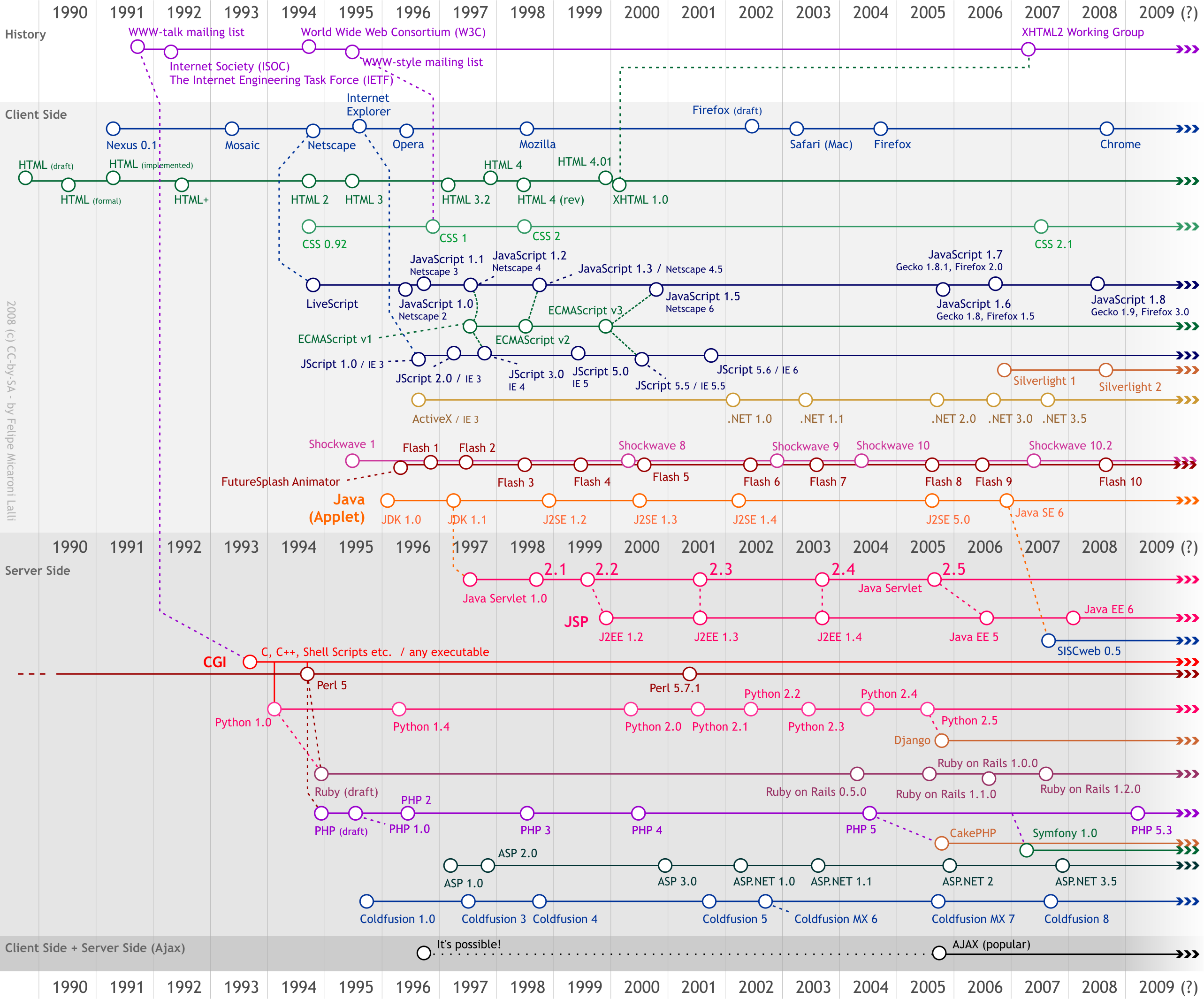
Un gráfico suele ayudar a entender un problema, particularmente las líneas de tiempo. Publicadas en Wikipedia, dos "timelines" sobre evolución de lenguajes y de browsers tienen la virtud de hacer visible el fulminante crecimiento de Internet como carril del desarrollo del software. Con trabajos precursores a finales de los ochenta, a partir de la década del 90 su crecimiento convirtió cualquier predicción sobre su evolución en hechos consumados en pocos años, retroalimentando una espiral de crecimiento que abre posibilidades apenas imaginadas quince años antes. Un impacto que promete cambiar profundamente las posibilidades de conocimiento del conjunto de la sociedad urbana.
Aquí se publica uno de ellos. El otro, se lo puede encontrar en Wikimedia.

Los artículos de Wikipedia que los sustentan son History of the web browser, y Web development.
sábado, mayo 23, 2009
Plex: Webclient i+
ADC Austin anuncia este mes su release 1.4.6 de su Webclient, la alternativa que desarrollara en conjunto con Websydian, basado en modelos Plex. Para quien no conozca el producto, esta es la presentación resumida en su wiki:
Volveremos sobre el tema.
Crecientemente, distintos socios de CA, embarcados en extender Plex, exploran las nuevas tendencias en Model Driven Design para lograr mayor alcance, tanto para crear puentes con otras aplicaciones y paradigmas de modelo, como para abordar nuevas plataformas y arquitecturas. Este es uno de los ejemplos en curso. Cobra importancia Eclipse en este y otros proyectos.WebClient is an extension to the CA Plex development environment. It allows CA Plex-developed Java GUI applications to be deployed as web applications with minimal modifications.
In order to use WebClient to deploy an application, you must:
- Have an application that is configured for and operational as a Plex Java client/server application
- Have a Java EE-compliant web application server
- Build and deploy the application using the Eclipse development environment
WebClient consists of two principal components:
- A template generator which runs during the generate and build process. For each Plex GUI panel, a file is generated which contains the HTML and Javascript code needed to display the panel as a web page. The generated templates can be customized to alter the look and feel, implement new controls, and provide additional functionality to the panels.
- A servlet that is loaded into the Java EE application server at runtime. The servlet loads the Plex-generated Java application's class files and allows them to communication to and from the web user using the generated templates.
Volveremos sobre el tema.
martes, marzo 24, 2009
Swift, un experimento sobre seguridad en Web
Lambda The Ultimate comenta un ensayo en curso que parece muy interesante: Swift, un sistema que basa la construcción de aplicaciones web en la utilización de una extensión de Java que aplica políticas de seguridad, y en tiempo de compilación divide el código entre JavaScript en el cliente, y Java en el servidor. Para seguir, tenga éxito o no. Presentación en Lambda...:
La presentación en el sitio de Swift:Swift: making web applications secure by construction
Swift is a language-based approach to building web applications that are secure by construction. Swift applications are written in the Jif language, a Java-based language that incorporates "security-typing" to manage the flow of information within an application. The Swift compiler automatically partitions the application code into a client-side JavaScript application and a server-side Java application, with code placement constrained by declarative information flow policies that strongly enforce the confidentiality and integrity of server-side information.
Swift was recently featured in the "Research Highlights" section of the Communications of the ACM, as a condensed version of an earlier conference paper. The original conference paper is Stephen Chong, Jed Liu, Andrew C. Myers, Xin Qi, K. Vikram, Lantian Zheng, and Xin Zheng, Secure web applications via automatic partitioning, Proceedings of the 21st ACM Symposium on Operating Systems Principles (SOSP'07), pages 31–44, October 2007.
En la base del sistema está Jif, que es descripto así en su sitio:Swift is a new, principled approach to building web applications that are secure by construction. Web applications are hard to build because code and data need to be partitioned to make them responsive. They are also hard to build because code and data need to be partitioned for security. Currently there are no good methods for deciding when it is secure to move code and data to the client side.
Because of the connection (and tension) between the problems of security and interactive performance, Swift addresses both at once, automatically partitioning application code while providing assurance that the resulting placement is secure and efficient.
In the Swift approach, application code is written in the Jif language, a Java-based language that includes information security policies. The source code is automatically partitioned into JavaScript code running in the browser, and Java code running on the server. For interactive performance, code and data are placed on the client side where possible. Security-critical code is placed on the server and user interface code is placed on the client. Code placement is constrained by high-level, declarative information flow policies that strongly enforce the confidentiality and integrity of server-side information. The Swift compiler may also choose to replicate code and data across the client and server, with benefits for both security and performance.
Jif is a security-typed programming language that extends Java with support for information flow control and access control, enforced at both compile time and run time. The source code for the Jif compiler and run-time system is now available for download. Jif is written in Java and is built using the Polyglot extensible Java compiler framework.¿Podría agregarse una capa más, para crear el código que luego se compilará?. Para investigar, en la hora 25 del día...
Static information flow control can protect the confidentiality and integrity of information manipulated by computing systems. The compiler tracks the correspondence between information the policies that restrict its use, enforcing security properties end-to-end within the system. After checking information flow within Jif programs, the Jif compiler translates them to Java programs and uses an ordinary Java compiler to produce secure executable programs.Jif extends Java by adding labels that express restrictions on how information may be used. For example, the following variable declaration declares not only that the variable
xis anint, but also that the information inxis governed by a security policy:int {Alice→Bob} x;In this case, the security policy says that the information in
xis controlled by the principal Alice, and that Alice permits this information to be seen by the principal Bob. The policy{Alice←Bob}means that information is owned by Alice, and that Alice permits it to be affected by Bob. Based on label annotations like these, the Jif compiler analyzes information flows within programs, to determines whether they enforce the confidentiality and integrity of information.
lunes, septiembre 08, 2008
Google Chrome en InfoQ

En estos días, varios millones de entusiastas están probando Chrome, el browser de Google (me incluyo), en su primer lanzamiento público. Evidentemente, se ha lanzado una carga de profundidad en el mercado, que, como otros productos de su dueño, apenas comienza, y mucho más veremos.
Geoffrey Wiseman, en InfoQ, publica un breve pero abarcador artículo sobre estado y perspectivas, que es conveniente leer.
En cuanto al escenario en la industria, Wiseman estima:
En su resúmen técnico, Wiseman escribe:Many people have heralded the launch as the renewal of the browser wars once fought between Microsoft and Netscape / Mozilla (those were the primary contenders, although every browser has its contigent willing to trumpet its strengths). Some are willing to count Chrome out already, while others are adopting a wait and see stance.
Many argue that Google doesn't wish to compete with other browsers, simply to advance the state of network-delivered applications to where they are indistinguishable from desktop applications and in so doing, push the operating system into the background.
In particular, people telling this story love to cast Microsoft in the opposing role, so that one can imagine the two titans clashing.
Por mi parte, no reemplazaré (por ahora) a Firefox, porque aún Chrome es incompleto para algunos de los usos que hoy mantengo en Firefox, pero sus ventajas por ahora son innegables, y en primer lugar, en performance. En Septiembre, la lucha ha comenzado.The Chrome browser is the result of the Chromium project, which connects the WebKit web browser engine with the new Google V8 JavaScript Engine, the Skia vector graphics engine, and Google Gears.
The WebKit browser engine began its life as a fork of the KDE project's KHTML and KJS engines by Apple, becoming the basis of the Safari browser. WebKit was later re-adopted by KDE. Google already employs WebKit within their Android mobile phone platform, and it became the obvious solution for them. As the comic introduction to Chrome states:
It uses memory efficiently, was easily adapted to embedded devices, and it was easy for new browser developers to learn to make the code base work. Browsers are complex. One of the things done well with WebKit is that it's kept SIMPLE.
The version of WebKit used in the initial Windows beta seems to be WebKit 525.13, which is not the most recent version, and has some security vulnerabilities (see Security below). Some users have also noticed rendering differences from Safari's WebKit rendering to Chrome's, including antialiasing and shadows. This may be the result of the Skia graphics engine used under the hood.
Talking about the integration with WebKit, the Chromium FAQ says:
The Chromium source code includes a copy of the WebKit source. We frequently snapshot against the WebKit tip of tree or specific branches according to our release needs.
Our goal is to reduce the size and complexity of the differences between the copy we maintain in order to work more effectively as a participant in the WebKit community and also to make periodic updates occur more smoothly.
The V8 JavaScript Engine is open-source and hosted on Google Code, but was written for Chrome, rather than adopting an existing JavaScript engine. V8 is written in ~100,000 lines of C++ and can be run standalone or embedded in C++ applications.
The foremost reason for V8's creation seems to be performance. The V8 Design Documentation states, "V8 is ... designed for fast execution of large JavaScript applications." The Chromium Blog on V8 is entitled "The Need for Speed" and states:
Google Chrome features a new JavaScript engine, V8, that has been designed for performance from the ground up. In particular, we wanted to remove some common bottlenecks that limit the amount and complexity of JavaScript code that can be used in Web applications.
V8 claims a number of performance improvements and innovations, from fast property access using hidden classes, dynamic machine code generation and efficient garbage collection (stop-the-world, generational, accurate, compacting), small object hreaders, multi-threaded from the ground up. The team that created V8 was headed by Lars Bak, who, as Avi Bryant says, was "the technical lead for both Strongtalk and the HotSpot Java VM, and a huge contributor to the original Self VM" and has a number of VM-related patents to his name.
V8 is not a virtual machine in the classic sense as Matthieu Riou points out: there's no intermediate representation or byte-code. As a result, you cannot write your own language that compiles to "V8 byte code", although you can cross-compile to JavaScript. Despite this, Dave Griswold believes that V8 could serve as the engine for other dynamic languages:
I think these properties will rapidly make V8 the dominant VM for dynamic languages. It ought to make a great platform for Smalltalk.
Google Gears has also moved into the Chromimum Project, as pointed out in the FAQ:
With Gears as a plug-in to Chromium we're carrying two copies of sqlite and two copies of V8. That's silly. We're integrating the code so Gears can run great in Chromium. We plan to continue to build Gears for other browsers out of the same code base.
Although Google Chrome supports plugins for content handling like Flash and PDF, it does not currently support browser extensions, although that is planned.
sábado, junio 28, 2008
Facebook o LinkedIn?
Hace alrededor de tres semanas, mis ex-colegas de Chile me invitaron a abrir una cuenta en Facebook: primero uno, luego dos más. Finalmente, aunque me resistía a dedicar tiempo a este tipo de redes, acepté, para mantener contacto con ellos, y recordar lo que ya es irrepetible (Pero este es otro asunto). Luego, otro más me invitó a MySpace, y acepté porque es un colega que lo merece; y finalmente ayer, recibí dos invitaciones de Argentina y Honduras de colegas y amigos con los que no quiero perder contacto para otra red, Tagged, a la que ya había rechazado varias veces (y que continuaré haciendo). El futuro me presenta una tarea: convencer a todos los colegas y amigos a que converjamos en una sola red. No pensaba dedicar tiempo a ninguna; de hecho estaba rechazando invitaciones, y explicando por qué lo hacía. Sin embargo, tengo que reconocer que Facebook tiene aspectos de interés: es un sitio informal para conversar con quienes están lejos, como en general es mi caso, y la oferta de aplicaciones disponibles es más que variada; así como es posible dedicarse a (cientos) de juegos, y estar a un nivel de proximidad adolescente, así también es posible encontrar comunidades de gran interés, expresadas a través de actividades de grupos de afinidad o del uso de aplicaciones. Luego de hacer una revisión de semanas, mi adhesión a grupos dedicados a lenguajes de programación , herramientas y actividades en la Web, trabajo y emprendedores se ha vuelto descontrolada. Sé por experiencia que, andando el tiempo, esas pequeñas comunidades desarrollan intereses comunes sólidos. ¿Cuánto tiempo se le puede dedicar?. Poco; terminaré creando un sistema de alertas, y consolidando las relaciones con una pequeña porción de ese universo.
Un fenómeno curioso, que creo que va camino de la simplificación, es el predominio de la adhesión por naciones: Según comentan, y pude comprobar, Orkut es un excelente sitio para estar en contacto con personas de Brasil, y parecería que también de India. Es abrumadora la cantidad de personas de Chile participando en Facebook.
Pero yendo al asunto inicial, Facebook o LinkedIn?
Tengo la impresión de que las redes del estilo de Facebook son la continuidad con mayor alcance e interactividad, de lo que Messenger o los fotologs representaron: un sitio para conectarse informalmente, mayoritariamente para jóvenes, y para el ocio. Messenger creció por su decidida apuesta a capturar el mercado de los jóvenes; muchas de estas redes no despegan de ese modelo. Y esta es la razón por la que visito Messenger sólo una vez cada tanto, si acaso un amigo o familiar lo usa y tenemos que conversar. De lo contrario, de manera más espartana, se puede conversar con Google Talk. Lo mismo vale para las redes sociales. Estimo que este modelo es su límite. Y LinkedIn (o Xing) representan la reacción a él. Estas redes son, contrariamente, económicas en su presentación, con nula oferta de ocio o expansión informal (ni albumes de fotografía, ni videos, ni expresiones de deseos o fanatismos, ni citas amorosas). Sólo el desarrollo de herramientas de presentación profesional o académica, y de colaboración, con reglas rigurosas de protección de información. No se fomenta el trato indiscriminado, estableciendo un esquema conservador de presentación. Pero el resultado es muy valioso; en mi caso, me ha permitido estar en contacto con colegas que de otra manera difícilmente hallaría. Y las herramientas disponibles me estan ayudando a planificar actividades que de otra manera resultarían complicadas. En el terreno de facilidades para las actividades laborales, profesionales o académicas, comienzan a ofrecer poderosos medios de trabajo.
¿Qué le espera a las redes sociales? Creo que la diversidad que hay ahora se simplificará pronto, y que muchas de ellas están en una carrera para ver quién las compra, y a cuánto. Esto también vale para las profesionales, pero por su propio carácter, creo que un margen de competencia quedará. Sea como sea, en un futuro próximo, creo que me ahorrarán el dilema de qué hacer con tantas invitaciones, porque todo el agua irá al mar.
Finalmente, quiero destacar algunos aspectos señalados por Brad Stone, de New York Times, sobre LinkedIn:
The average age of a LinkedIn user is 41, the point in life where people are less likely to build their digital identities around dates, parties and photos of revelry.Sobre las bases del negocio de LinkedIn:
LinkedIn gives professionals, even the most hopeless wallflower, a painless way to follow the advice of every career counselor: build a network. Users maintain online résumés, establish links with colleagues and business acquaintances and then expand their networks to the contacts of their contacts. The service also helps them search for experts who can help them solve daily business problems.
The four-year-old site is decidedly antisocial: only last fall, after what executives describe as a year of intense debate, did the company ask members to add photos to their profiles.
That business-only-please strategy appears to be paying off. The number of people using LinkedIn, based in Mountain View, Calif., tripled in May over the previous year, according to Nielsen Online. At 23 million members, LinkedIn remains far smaller than Facebook and MySpace, each with 115 million members, but it is growing considerably faster.
LinkedIn also has a more diversified approach to making money than its entertainment-oriented rivals, which are struggling to bring in ad dollars and keep up with inflated expectations for increased revenue.
LinkedIn will get only a quarter of its projected $100 million in revenue this year from ads. (It places ads from companies like Microsoft and Southwest Airlines on profile pages.) Other moneymakers include premium subscriptions, which let users directly contact any user on the site instead of requiring an introduction from another member.
A third source of revenue is recruitment tools that companies can use to find people who may not even be actively looking for new jobs. Companies pay to search for candidates with specific skills, and each day, they get new prospects as people who fit their criteria join LinkedIn.
Un aspecto que se incrementará, pero que ya está presente, es el lugar que las empresas tendrían:
Reid Hoffman, de la dirección de LinkedIn, y anterior inversor en Facebook, compara ambos:LinkedIn is set to undergo a radical shift in strategy to find other sources of revenue. Instead of catering primarily to individual white-collar workers, the site will soon introduce new services aimed at companies. It is a risky move that could alienate members who prefer to use the networking site to network — without their bosses peering over their shoulders.
One new product, Company Groups, automatically gathers all the employees from a company who use LinkedIn into a single, private Web forum. Employees can pose questions to each other, and share and discuss news articles about their industry.
Soon, LinkedIn plans to add additional features, like a group calendar, and let independent developers contribute their own programs that will allow employees to collaborate on projects.
The idea is to let firms exploit their employees’ social connections, institutional memories and special skills — knowledge that large, geographically dispersed companies often have a difficult time obtaining.
(...) “It will be extraordinarily challenging to simultaneously serve as a corporate tool and yet promote the ‘brand of me’ in an emerging free-agent nation,” said Keith Rabois, a former LinkedIn executive who is now vice president at Slide, a maker of applications for social networks.
Jeffrey Glass, a partner at Bain Capital, says his firm invested in LinkedIn primarily because it is now becoming popular enough to introduce these kinds of products to companies and other organizations, like universities.
“This is a powerful tool because inside the corporation, there are massive bodies of knowledge and relationships between individuals that the corporation has been unable to take advantage of until now,” he said.
(...) he said that most members of Facebook who are older than 30 use it for entertainment, like playing Scrabulous, a version of Scrabble — not for doing their jobs.
“Scrabulous is not work, and it does not enable you to be an effective professional,” he said.
sábado, febrero 16, 2008
Compartiendo intereses
Google Reader amplió el alcance de los ítems compartidos: desde hace algún tiempo (pocas semanas), es posible no sólo presentar en otra página los feeds de interés que el lector destaque, sino que ahora, si los creadores de las entradas leídas son también contactos del lector, sus propias lecturas destacadas aparecen listadas: una manera rápida de compartir intereses con colegas y amigos, a condición de que el seguimiento que los colegas y amigos apunten en el mismo sentido.
De todas formas, más potente sigue siendo para esto del.icio.us, cuya única limitación insalvable sigue siendo la fragilidad de Internet: un enlace vale en tanto el servidor que lo sostenga no cambie el criterio de alojamiento, o peor aún, desaparezca (¿Alguien consiguió establecer un seguimiento seguro de un tema de interés en MSDN, al momento de que su producto cambie de versión?) Quizá en el futuro pueda concertarse un sistema de identificación que deje a salvo las variaciones de ubicación de los sitios, pero por ahora, mi único auxiliar es The Internet Archive, capaz de dar algo de eternidad a lo que se construya en la Red.
De paso, del.icio.us es una de las razones por las que espero que Yahoo no sea comprada.
jueves, enero 03, 2008
Ocho tendencias para seguir en 2008 (Según McKinsey)
La actualización de noticias de The McKinsey Quarterly publica un artículo de Diciembre, firmado por James M. Manyika, Roger P. Roberts, y Kara L. Sprague, que recomiendo leer: "Eight business technology trends to watch". Las ocho tendencias implican mayoritariamente la utilización de redes, Internet, y la participación externa a las empresas:
1. Cocreación distribuida:
1. Cocreación distribuida:
The Internet and related technologies give companies radical new ways to harvest the talents of innovators working outside corporate boundaries. Today, in the high-technology, consumer product, and automotive sectors, among others, companies routinely involve customers, suppliers, small specialist businesses, and independent contractors in the creation of new products. Outsiders offer insights that help shape product development, but companies typically control the innovation process. Technology now allows companies to delegate substantial control to outsiders—cocreation—in essence by outsourcing innovation to business partners that work together in networks. By distributing innovation through the value chain, companies may reduce their costs and usher new products to market faster by eliminating the bottlenecks that come with total control.2. Los consumidores como innovadores:
As the Internet has evolved—an evolution prompted in part by new Web 2.0 technologies—it has become a more widespread platform for interaction, communication, and activism. Consumers increasingly want to engage online with one another and with organizations of all kinds. Companies can tap this new mood of customer engagement for their economic benefit.3. Acudiendo al talento global:
4. Extrayendo mas valor de las interacciones:As more and more sophisticated work takes place interactively online and new collaboration and communications tools emerge, companies can outsource increasingly specialized aspects of their work and still maintain organizational coherence. Much as technology permits them to decentralize innovation through networks or customers, it also allows them to parcel out more work to specialists, free agents, and talent networks.
Top talent for a range of activities—from finance to marketing and IT to operations—can be found anywhere. The best person for a task may be a free agent in India or an employee of a small company in Italy rather than someone who works for a global business services provider. Software and Internet technologies are making it easier and less costly for companies to integrate and manage the work of an expanding number of outsiders, and this development opens up many contracting options for managers of corporate functions.
5. Expandiendo las fronteras de la automacion:Companies have been automating or offshoring an increasing proportion of their production and manufacturing (transformational) activities and their clerical or simple rule-based (transactional) activities. As a result, a growing proportion of the labor force in developed economies engages primarily in work that involves negotiations and conversations, knowledge, judgment, and ad hoc collaboration—tacit interactions, as we call them. By 2015 we expect employment in jobs primarily involving such interactions to account for about 44 percent of total US employment, up from 40 percent today. Europe and Japan will experience similar changes in the composition of their workforces.
The application of technology has reduced differences among the productivity of transformational and transactional employees, but huge inconsistencies persist in the productivity of high-value tacit ones. Improving it is more about increasing their effectiveness—for instance, by focusing them on interactions that create value and ensuring that they have the right information and context—than about efficiency. Technology tools that promote tacit interactions, such as wikis, virtual team environments, and videoconferencing, may become no less ubiquitous than computers are now. As companies learn to use these tools, they will develop managerial innovations—smarter and faster ways for individuals and teams to create value through interactions—that will be difficult for their rivals to replicate. Companies in sectors such as health care and banking are already moving down this road.
Companies, governments, and other organizations have put in place systems to automate tasks and processes: forecasting and supply chain technologies; systems for enterprise resource planning, customer relationship management, and HR; product and customer databases; and Web sites. Now these systems are becoming interconnected through common standards for exchanging data and representing business processes in bits and bytes. What’s more, this information can be combined in new ways to automate an increasing array of broader activities, from inventory management to customer service.6. Desagregando el manejo de la entrega de productos:
7. Poniendo más ciencia en el gerenciamiento:Technology helps companies to utilize fixed assets more efficiently by disaggregating monolithic systems into reusable components, measuring and metering the use of each, and billing for that use in ever-smaller increments cost effectively. Information and communications technologies handle the tracking and metering critical to the new models and make it possible to have effective allocation and capacity-planning systems.
Just as the Internet and productivity tools extend the reach of and provide leverage to desk-based workers, technology is helping managers exploit ever-greater amounts of data to make smarter decisions and develop the insights that create competitive advantages and new business models. From “ideagoras” (eBay-like marketplaces for ideas) to predictive markets to performance-management approaches, ubiquitous standards-based technologies promote aggregation, processing, and decision making based on the use of growing pools of rich data.8. Haciendo negocios de la información:
Accumulated pools of data captured in a number of systems within large organizations or pulled together from many points of origin on the Web are the raw material for new information-based business opportunities.Esto sólo es una presentación. Como se ha dicho, el artículo debe leerse. Cada ítem está acompañado por bibliografía.
Suscribirse a:
Entradas (Atom)