Mostrando las entradas con la etiqueta W3C. Mostrar todas las entradas

martes, junio 16, 2009

Rápida y breve historia del desarrollo en la Web


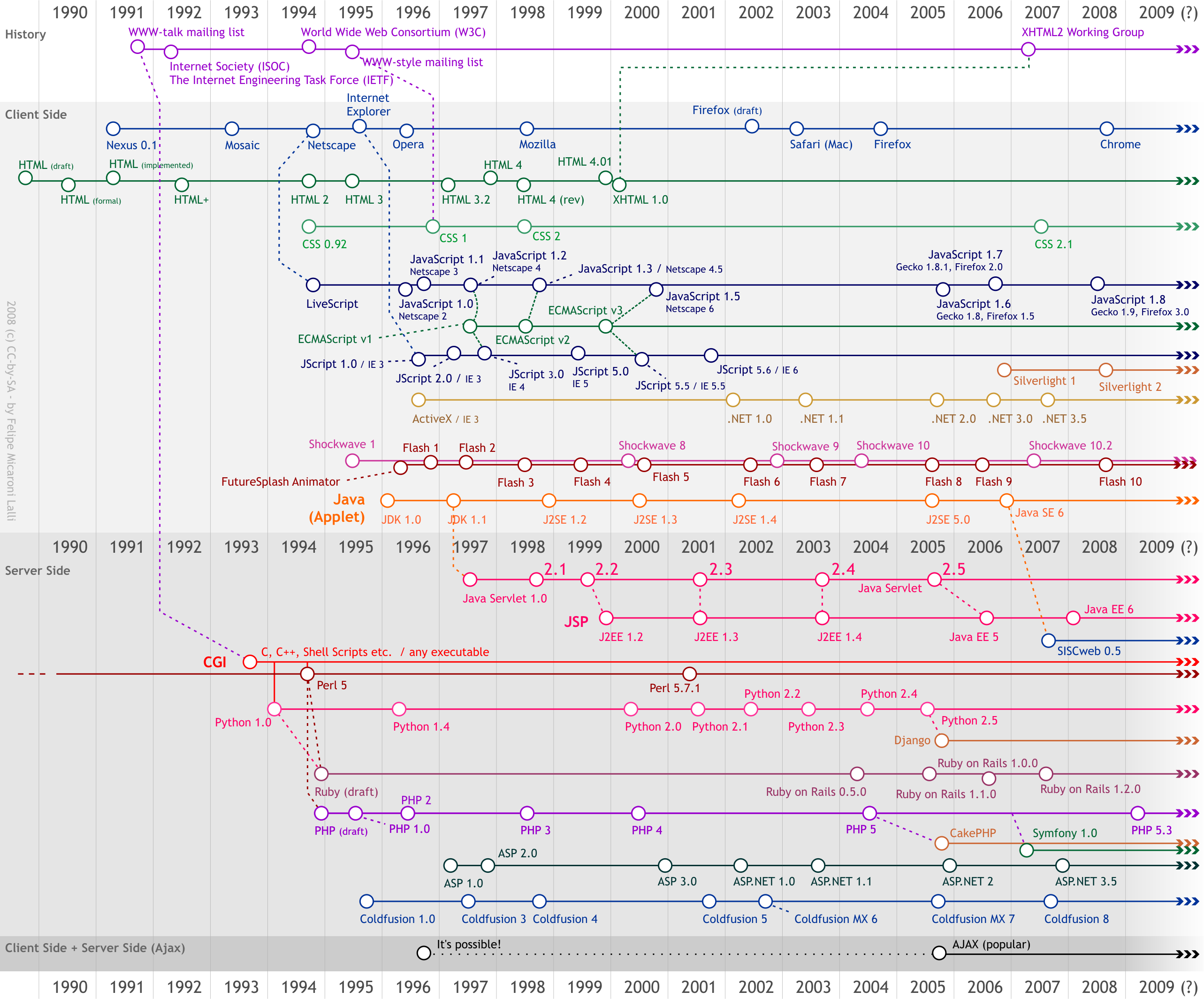
Un gráfico suele ayudar a entender un problema, particularmente las líneas de tiempo. Publicadas en Wikipedia, dos "timelines" sobre evolución de lenguajes y de browsers tienen la virtud de hacer visible el fulminante crecimiento de Internet como carril del desarrollo del software. Con trabajos precursores a finales de los ochenta, a partir de la década del 90 su crecimiento convirtió cualquier predicción sobre su evolución en hechos consumados en pocos años, retroalimentando una espiral de crecimiento que abre posibilidades apenas imaginadas quince años antes. Un impacto que promete cambiar profundamente las posibilidades de conocimiento del conjunto de la sociedad urbana.
Aquí se publica uno de ellos. El otro, se lo puede encontrar en Wikimedia.
Los artículos de Wikipedia que los sustentan son History of the web browser, y Web development.

domingo, mayo 25, 2008

La defensa de los estándares abiertos

Acabo de leer la nota de Alejandro Pisanty mencionando la creación del grupo Digistan, dedicado a la defensa de estándares abiertos en el ámbito de Internet, como secuela de la ajetreada discusión del estándar OOXML. La carta abierta de sus fundadores debiera motivar su respaldo:

Industry has always depended on standards and traditional industries have built their standards as part of a slow, controlled, top-down approach to innovation. Industrial-age standards are often heavily patented, complex, and large. They can be expensive to implement and therefore are implementable only for large established firms.
But almost forty years ago, Steve Crocker and his team wrote RFC001 and launched the networks that built the Internet using a different model based on older human values of sharing and cooperation. His vision, and that of other Internet pioneers, was of a digital world built on simple, interoperable standards, accessible at zero cost to even the smallest teams. Largely, their dream is coming true. Today we're used to an Internet of open software, open content, and open development.
While most agree, not everyone likes it. In the telecoms, entertainment, and software industries we see the destruction of legacy vendors and their replacement by new Internet communities. And many of the old industrial businesses, instead of adapting, are fighting back. The fight is intensifying because the stakes are growing. Free and open source software, open content, and open communities are together worth trillions of dollars. The key to controlling these rich ecosystems is to control the digital standards they depend on.
The outcome of this conflict will define our digital future. At one extreme, Steve Crocker's vision comes true, and the future is built on free and open digital standards. And at the other extreme, the legacy telecoms, entertainment and software vendors capture the world's digital standards by controlling the standardization processes and by using software patents.
Imagine the world if RFC001 was owned by a consortium of telecoms firms. Imagine if only those firms, and their approved partners, could develop Internet technologies. Imagine if every RFC was protected by dozens of patents, so that sending a single email or downloading a web page meant paying license fees. Imagine paying for each click. Look at your mobile phone bill and you see how close this reality is. [sigue...]

OOXML en Wikipedia.
La controversia sobre este proceso en inglés, y en castellano.
Sobre este proceso, claro ejemplo y motivo de lo que se defiende en la carta, hay mucho material disponible, tanto que no vale la pena entrar más en detalles.
Sobre Digistan, la iniciativa no se limita a un observatorio ético, sino que trabaja en la elaboración de instrumentos.
domingo, diciembre 16, 2007

Diseño web, no sólo adopción de estándares

Diego Lafuente escribe dos palabras sobre un problema que es una molestia constante: la demora en la carga de algunos sitios. La particularidad de su observación es que muestra que no sólo se trata de adherir a estándares, sino de cómo se piense la arquitectura de lo que se va a poner en movimiento. Una estadística más o menos informal muestra un muy alto número de peticiones http por página en cualquiera de los periódicos on line que analiza, sean nacionales o de nivel mundial. Leer en su orígen.

domingo, noviembre 04, 2007

Un poco de humor para analizar la Web


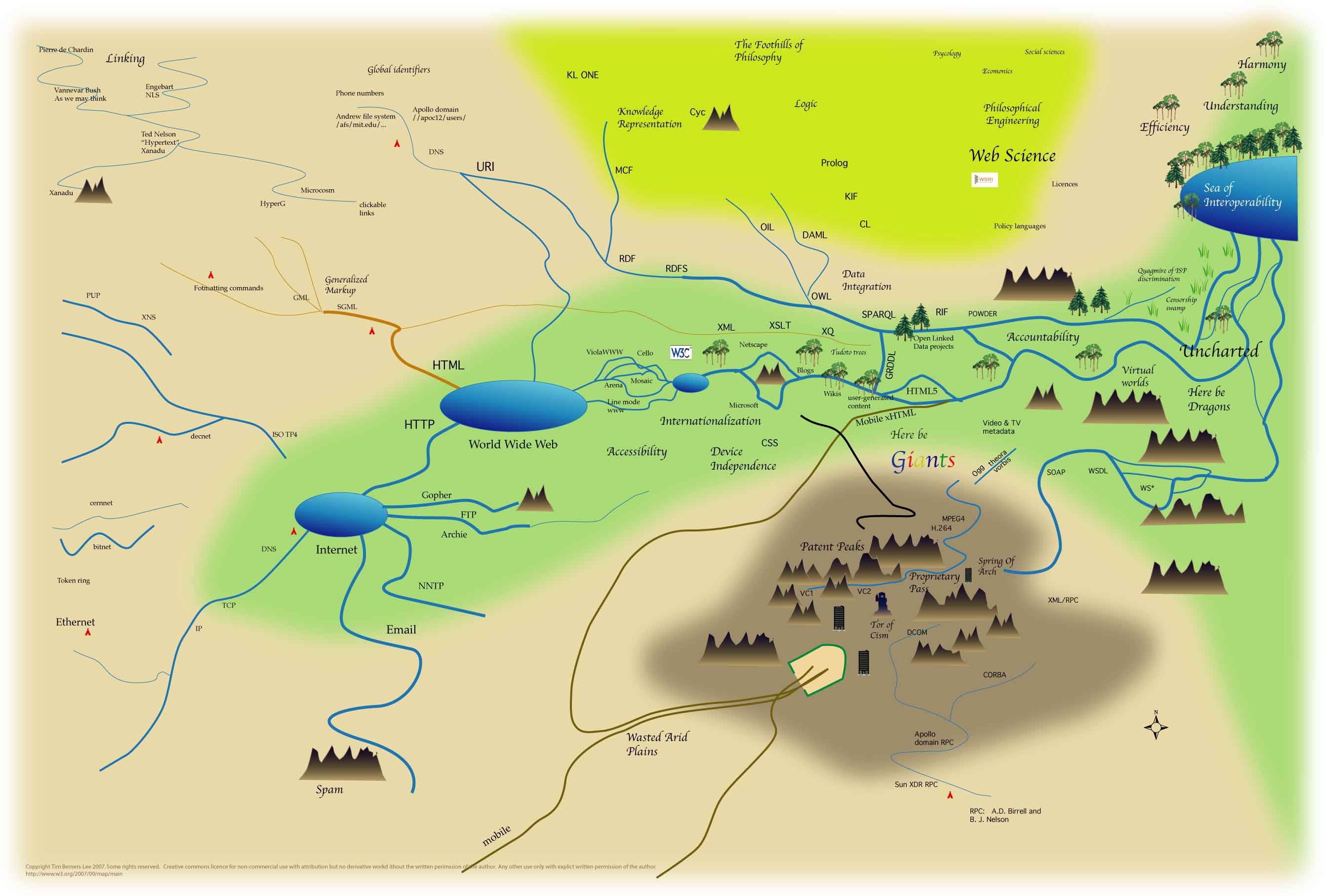
InfoQ publica una pequeña nota sobre el trabajo de Paul Downey, quien creó un mapa de la web combinando algo de su historia, sus estándares y otras relaciones, como si fuera el mapa de la Tierra Media del Señor de los Anillos. Siguiendo la nota, aparece otro intento similar, comentado por Amivdh, alojado en W3C. Arriba, los dos "mapas".
La nota de InfoQ:
Paul Downey from BT has produced an adventuring map for the Web in the style of that used by the Fellowship of the Ring, or Bilbo. It includes historical aspects, relationships to standards and other wonderful visualizations. Using a Web 2.0 approach, the original map is augmented with various call-outs to emphasize different aspects, such as "Google's all seeing eye", Mordorsoft and "FUD" in what would be Mordor, the Tower of WS-Babel, which is surrounded by the Swamp of BPEL and the Ruins of CORBA. Although probably starting out as a fun way to visualize the world of SOA, Web Services and the Web in general, it makes some interesting points (such as the reference to the Maelstrom of Incompatibility and the Lost Tribe of UDDI).

Downey dejó disponible un detallado pdf sobre su mapa. El sitio en Flickr también permite un recorrido detallado de cada parte del mapa, en fotografías sucesivas.