I recently noticed more and more often how badly applications within the typical large-scale enterprise suck, and how much they would profit from some basic Web sanity applied to them. But for some reason, many enterprise software developers, whether they’re working with the .NET platform or with Java (more common among our customers), still believe that their software is different from what people use on the Web.
I’ve become convinced that you need something like an Eclipse RPC or Swing app only in very exceptional circumstances, most of which are usually not there in typical enterprise apps. The benefits of being able to centrally change something without having to deploy some sort of client alone usually outweigh any perceived or real disadvantages. But even if you don’t care about this aspect (because of the super-smart software roll-out solution you have), I still think that there are many more benefits of building Web apps:
- Your users probably don’t care much about the things you think they do. They basically want to find information, enter some data, hit a button, enter some more data, and be done with it. They don’t care about being able to use the right mouse button, don’t care for dragging and dropping things, and entirely happy with a pretty basic design.
- Even if you want to add some of these things, there are pretty easy to do nowadays with simply CSS and Ajax magic (no need for anything fancy like Air or Silverlight or Flash)..
But even if you buy into these arguments, many people still build Web apps that suck. Both within the enterprise as well as on the Web, I think good Web apps expose some, or ideally all of these characteristics:
- There are meaningful “entry points” into the app - URIs. (No, I’m not going to mention the R-word.) It’s simply entirely unacceptable for a Web app to expose only a single URI, break the “Back” button, and disallow linking. Frameworks that don’t support URIs for application concepts, such as every customer, order, contact report, document etc. should simply be banned.
- Application boundaries are a concern to developers, not users. The Web is about linking stuff together, without any concern about application boundaries. There’s absolutely no reason why you shouldn’t be able to follow a link in your CRM application that takes you to a product page in your online catalog, or from a customer record to the information about when they last logged in to the Web site, or from a page that’s part of a complex business process UI to the appropriate documentation and on to the discussion group where you can tell everybody how much it sucks.
- Documents are accessible in a standard way. The idea of accessing any kind of document, such as an insurance application form that’s been scanned in, a letter sent to a business partner last year, or a contract with a business partner, by any other means than an HTTP GET is just stupid.
In other words: Many web frameworks, especially those within the Java space, try to support the development of desktop applications that are delivered over the Web as opposed to “web sites”, and I believe this idea is deeply flawed: Any Web application should be measured against the criteria that are used to judge web sites.
If you are an enterprise developer building applications, I suggest that you consider turning them into web sites instead. Why not do what makes your users happy for a change?
sábado, septiembre 05, 2009
Algo más sobre la orientación a la Web en la construccion de aplicaciones


martes, junio 16, 2009
Rápida y breve historia del desarrollo en la Web
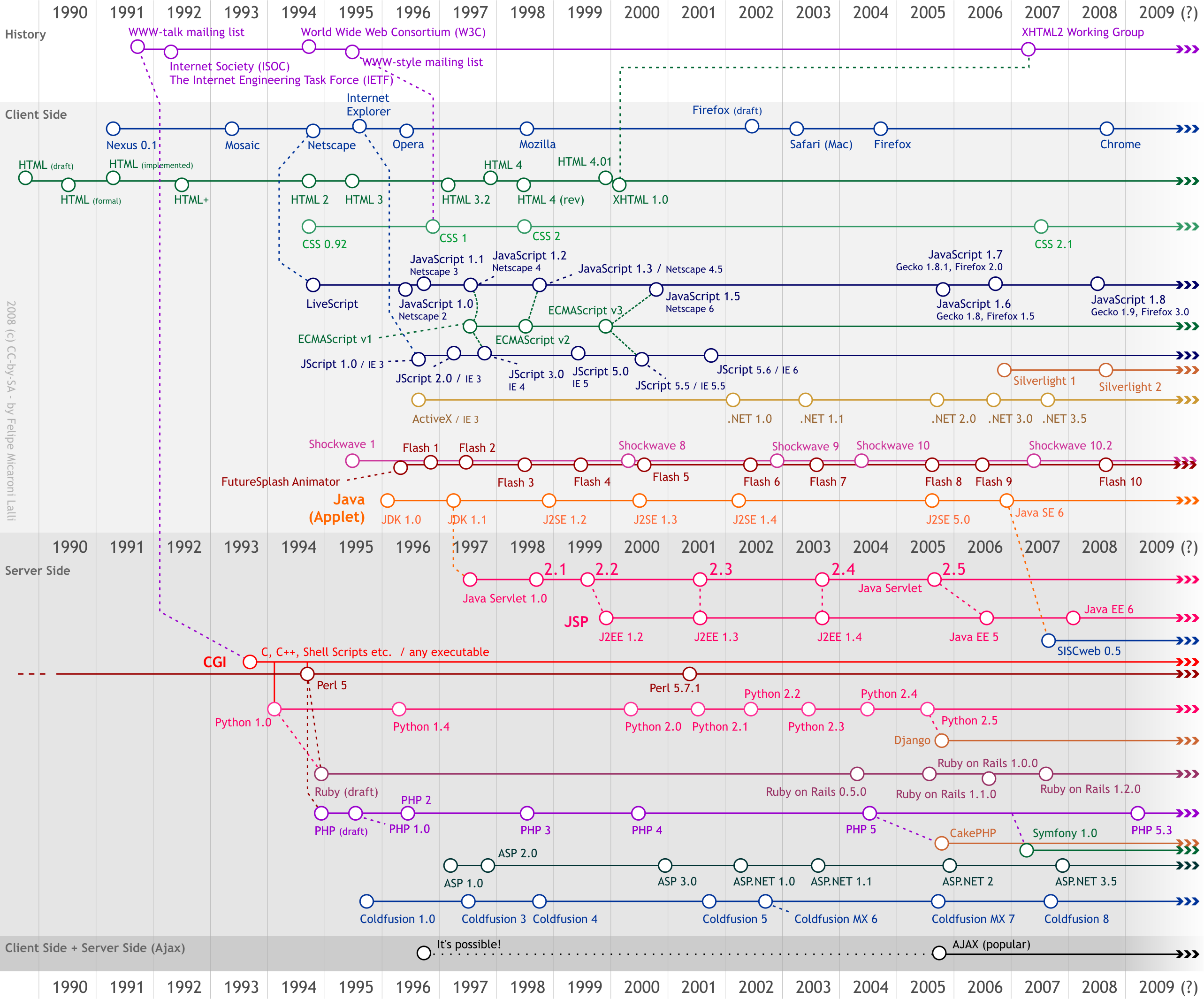
Un gráfico suele ayudar a entender un problema, particularmente las líneas de tiempo. Publicadas en Wikipedia, dos "timelines" sobre evolución de lenguajes y de browsers tienen la virtud de hacer visible el fulminante crecimiento de Internet como carril del desarrollo del software. Con trabajos precursores a finales de los ochenta, a partir de la década del 90 su crecimiento convirtió cualquier predicción sobre su evolución en hechos consumados en pocos años, retroalimentando una espiral de crecimiento que abre posibilidades apenas imaginadas quince años antes. Un impacto que promete cambiar profundamente las posibilidades de conocimiento del conjunto de la sociedad urbana.
Aquí se publica uno de ellos. El otro, se lo puede encontrar en Wikimedia.

Los artículos de Wikipedia que los sustentan son History of the web browser, y Web development.
sábado, diciembre 20, 2008
Zauber, Popego, Flof, entrando al siglo XXI

Zauber y Popego, junto a otros varios emprendimientos en curso en Argentina, representan parte de lo más destacable en un marco de grandes dificultades para hacer negocios. Si en general, el negocio del software se ha convertido en uno de los pocos que crecen fuerte en el país, estos casos de desarrollos originales, innovadores, son particularmente destacables, a pesar de que aún les queda camino por delante para consolidarse. Independientemente de que lo logren plenamente o no, estos, y otros parecidos, presentan características que escapan al marco conocido en que una empresa se desenvuelve en Argentina, y que se deben estudiar, extender, y multiplicar, tanto por número, como por alcance.
¿Cuáles son estas características?
- Por empezar por un punto, sus integrantes son jóvenes. Es decir, terminan la Universidad (o ni siquiera), y se sumergen directamente en un proyecto propio. Así, no han tenido tiempo de entrar en las prácticas y cultura empresarias argentinas. Durante mucho tiempo he pensado que es bueno para un jóven estudiante hacer algunos años de experiencia en el mundo empresario, especialemente en grandes corporaciones, para tener una idea de cómo es el mundo económico real; sin embargo, está claro que si esas prácticas no son de calidad, lo único que recogerán será excepticismo y medianía. Por el contrario, ser emprendedores tempranamente les ha dado ventaja.
- Además, mayoritariamente (si no todos) son universitarios, con base tecnológica. No sé si por casualidad, en los dos casos mencionados, con gran participación del ITBA (habrá que tenerlo en cuenta). Pertrechados con conocimiento de las nuevas tecnologías, buscando aplicaciones innovadoras, y asociados a colegas de su misma generación e intereses. Muy lejos del modelo histórico, basado en un emprendimiento familiar nacido de un pequeño negocio y mejorado a base de sangre, sudor, y lágrimas. Todos conocemos la historia del 70% de las empresas nacionales, como para entender la diferencia.
- Poseen visión global: no piensan en un modelo limitado a las posibilidades y alcance del país, sino en términos globales. Su orientación a negocios soportados por Internet les da la ventaja de pensar en un mercado de centenares de millones, no de cientos de miles de personas.
- No les fue necesario un gran capital, y el que necesitaron, lo fueron a buscar, con una audacia envidiable, a inversores no institucionales, apartándose en parte del penoso modelo de financiación de cualquier empresa nacional. Probablemente, con el modelo tradicional, todavía estarían tratando de nacer.
- Son innovadores en su objetivo de negocio: apuntan a áreas en donde está todo por hacer, y si no es así, encuentran un nicho de innovación. En el pasado, muchas empresas se han sumado a un mercado existente, y han dejado pasar los años sin promover cambios en su esquema.
Para ilustrar esto, nada mejor que leer los reportajes que Infobae les hizo a miembros de cada una de estas empresas, entre octubre y diciembre:
A Zauber, entrevistando a Martín Márquez, y a Popego, hablando con Santiago Siri.
(La entrevista a Márquez, se la debo a mi compatriota Mauro...)
(La fotografía, en Infobae, con el equipo de Zauber)
viernes, septiembre 26, 2008
(Thinking in Objects)
Henry propone un ejemplo (imperfecto y criticado por varios de sus lectores):In order to be able to have a mental theory one needs to be able to understand that other people may have a different view of the world. On a narrow three dimensional understanding of 'view', this reveals itself in that people at different locations in a room will see different things. One person may be able to see a cat behind a tree that will be hidden to another. In some sense though these two views can easily be merged into a coherent description. They are not contradictory. But we can do the same in higher dimensions. We can think of people as believing themselves to be in one of a number of possible worlds. Sally believes she is in a world where the ball is in the basket, whereas Ann believes she is in a world where the ball is in the box. Here the worlds are contradictory. They cannot both be true of the actual world.
To be able to make this type of statement one has to be able to do at least the following things:
- Speak of ways the world could be
- Refer to objects across these worlds
- Compare these worlds
Henry aboga por el uso de RDF (Resource Description Framework) como herramienta capaz de expresar adecuadamente las distintas vistas de un problema, en un universo de vistas en lugar de objetos. Pero sin duda, esto merece otro espacio.Let us illustrate this with a simple example. Let us see how one could naively program the puppet play in Java. Let us first create the objects we will need:
Person sally = new Person("Sally");So far so good. We have all the objects. We can easily imagine code like the following to add the ball into the basket, and the basket into the room.
Person ann = new Person("Ann");
Container basket = new Container("Basket");
Container box = new Container("Box");
Ball ball = new Ball("b1");
Container room = new Container("Room");basket.add(ball);Perhaps we have methods whereby the objects can ask what their container is. This would be useful for writing code to make sure that a thing could not be in two different places at once - in the basket and in the box, unless the basket was in the box.
room.add(basket);Container c = ball.getImmediateContainer();All that is going to be tedious coding, full of complicated issues of their own, but it's the usual stuff. Now what about the beliefs of Sally and Ann? How do we specify those? Perhaps we can think of
Assert.true(c == basket);
try {
box.add(ball)
Assert.fail();
} catch (InTwoPlacesException e) {
}sallyandannas being small databases of objects they are conscious of. Then one could just add them like this:sally.consciousOf(basket,box,ball);But the problem should be obvious now. If we move the ball from the basket to the box, the state of the objects in
ann.consciousOf(basket,box,ball);sallyandann's database will be exactly the same! After all they are the same objects!basket.remove(ball);There is really no way to change the state of the ball for one person and not for the other,... unless perhaps we give both people different objects. This means that for each person we would have to make a copy of all the objects that they could think of. But then we would have a completely different problem: namely deciding when these two objects were the same. For it is usually understood that the equality of two objects depends on their state. So one usually would not think that an physical object could be the same if it was in two different physical places. Certainly if we had a ball b1 in a box, and another ball b2 in a basket, then what on earth would allow us to say we were speaking of the same ball? Perhaps their name, if it we could guarantee that we had unique names for things. But we would still have some pretty odd things going on then, we would have objects that would somehow be equal, but would be in completely different states! And this is just the beginning of our problems. Just think of the dangers involved here in taking an object from
box.add(ball);
Ball sb = sally.get(Ball.class,"b1");
Assert.true(box.contains(sb));
//that is because
Ball ab = ann.get(Ball.class,"b1");
Assert.true(ab==sb);ann's belief database, and how easy it would be to by mistake allow it to be added tosally's belief store.
De los comentarios que siguen al artículo, particularmente abre un poco más el que hiciera Ryan, y la respuesta de Henry
Ryan:
I really like your analysis of OOP and it's relation to autism. I have never thought of it in such a way, but it does make a lot of sense (when I am able to remove my preconceptions). However, why is autism bad in this scenario (if you are even implying it)? I can understand that if our perspective is not an omniscient one then this can fail us. Would you please provide a applied example of the problem at hand with relation to your point on Semantic Web? Thanks a lot!Henry:
En el mismo sentido, apunta Benjamin Damman:Thanks for asking Ryan. Yes there are a lot of examples. The following article "Extending the Representational State Transfer (REST) Architectural Style for Decentralized Systems" which you can find here
http://portal.acm.org/citation.cfm?id=999447
makes the point about how the distance between the source of a message and the recipient of a message makes perfect immediate communication impossible, if you think of it as resources having the same access to an object. But if you think of it as message passing then you can do some interesting things... Ok I read that quickly, but that is what made me decide to write this article out today.In the AddressBook I am writing, which I describe in an audio slide cast here:
http://blogs.sun.com/bblfish/entry/building_secure_and_distributed_social
I need to get data from distributed places around the web. This can only be done seriously if you accept that there will be spammers, liars, and just simply wrong data out there. So though you may by default merge data, you may want to make it easy to unmerge it too. I wrote about that in more detail here:
http://blogs.sun.com/bblfish/entry/beatnik_change_your_mindAs I said, if you are writing tools, that you can think of as physical, mechanical objects, that don't have to have points of view on the universe, say if you are writing a web browser, a calculator, or some such thing, then this is not important. But as soon as you want to mesh the information on the web, you will need to take the opinion of others into account. We are fast moving to a world where this is going to become more and more important.
In any case it is good to know the limitations of your tools. :-)
Un papel sugerente de ideas, mas allá de los puntos observados por su crítica.Hmmmm. Parts of your intriguing article made me think of erlang.
"When one fetches information from a remote server one just has to take into account the fact that the server's view of the world may be different and incompatible in some respects with one's own. One cannot in an open world just assume that every body agrees with everything. One is forced to develop languages that enable a theory of mind. A lot of failures in distributed programming can probably be traced down to working with tools that don't."
Erlang was created for coding highly fault-tolerant (and distributed) systems; characteristics stemming this fact might make it an example of a language that 'enables a theory of mind.'
miércoles, abril 25, 2007
Mapa visual de la Web 2.0

Remito al post de Nacho Gallego, que refiere el mapa publicado por Microsiervos: una buena idea visual del significado de "Web 2.0". La introducción en Microsiervos:
Este Mapa Visual de la Web 2.0 es uno de los trabajos en que hemos colaborado en los últimos meses los dos microsiervos que trabajamos en Internality. Forma parte de una obra principal mayor, el libro La Web 2.0, publicado por la Fundación Orange y cuyos autores son Antonio Fumero y Genís Roca, con la colaboración especial de Fernando Sáez Vacas. El libro sigue la línea divulgativa de La Blogosfera hispana, una obra similar sobre el mundo de los weblogs se publicó el año pasado.
La idea del Mapa Visual de la Web 2.0 es que cualquier persona que quiera hacerse una idea de «qué es eso de la Web 2.0» pueda hacerlo de un vistazo, aunque no sepa mucho de Internet. El mapa agrupa de forma visual los principales conceptos que habitualmente se relacionan con la Web 2.0: software social, folksonomías, remezcla, participación, recomendaciones, simplicidad, etc. junto con una breve explicación de cada uno de ellos. Algunas de las explicaciones requerían un lenguaje demasiado técnico y algunos acrónimos (RSS, AJAX, API) de modo que en una zona reservada a modo de leyenda se incluyó un glosario para clarar los detalles importantes a los interesados en tecnicismos.
También se pensó desde el principio que sería interesante incluir ejemplos reales de proyectos de la Web 2.0, a los que cualquiera pudiera hacer una visita para entenderlos mejor. Para esa zona del mapa se seleccionaron algunos servicios de la Internet hispana que suelen enmarcarse en ciertas categorías genéricas habituales (weblogs, wikis, aplicaciones, agregadores, redes sociales, etc.). También se incluyeron, marcados con un icono especial, algunos proyectos «internacionales» de referencia obligada y que son bien conocidos por el público en general (YouTube, Del.icio.us, Flickr, etc.) y de hecho han inspirado a otros y popularizado muchos de los «conceptos Web 2.0».
domingo, marzo 11, 2007
Una Wiki sobre PHP en el ISeries
Welcome to Redwiki, the site for Redbooks in Wiki format!Los Red Books son los libros técnicos de casi todos los recursos disponibles de IBM. Este es el primer caso en que IBM utiliza a este nivel una wiki para crear conocimiento (Al menos, hasta donde conozco). En casos como éste, donde los usuarios pertenecen a una comunidad relativamente cerrada, la calidad de los aportes incorporados está casi garantizada.The objective of this residency it to update an existing redbook that describes the installation, configuration, porting issues (of other PHP applications to the iSeries), performance tips, and known best practices. The goal is to add more hands-on information that has been learned from experience with the product: code examples, tips and techniques, troubleshooting information, etc.
The ITSO is conducting this residency to create a deliverable that uses Wiki technology, as it is used by sites such as Wikipedia. You can be a part of a leading-edge pilot on a new way of delivering quality technical documentation. This residency is open to customers, business partners and IBM employees.
Note that this is not a typical residency. You will be working from your own location, as your time permits. This residency is slated as a three-month project, but we do not expect that you will be working on this full time. We do, however, expect individuals who are involved in this project to make significant contributions to the Wiki. In addition, unlike a typical residency where we have only 3 to 6 residents, for this project, we are looking for a much larger number of authors - perhaps as many as 20 people - who can work part time on the project.
If you would like to participate in this project, please visit this link
and register as a resident. Describe why you would like to take part, and what you feel you have to offer to the project.
Se puede consultar en PDF el Red Book al que se pretende extender. La wiki en sí, aquí.
Comentado por System iNetwork.
jueves, enero 18, 2007
SOA: interesante análisis de sus puntos flojos en Wikipedia
One of the criticisms of SOA is that the addition of XML layers introduces XML parsing and composition. In the absence of native or binary forms of Remote Procedure Calls (RPCs) applications may run slower and require more processing power, which increases costs.Another criticism of SOA is that the services are just stateless. According to www.xml.com, Stateful service is difficult to avoid in a number of situations. One situation is to establish a session between a consumer and a provider. A session is typically established for efficiency reasons. For example, sending a security certificate with each request is a serious burden for both any consumer and provider. It is much quicker to replace the certificate with a token shared just between the consumer and provider. Another situation is to provide customized service.
Stateful services require both the consumer and the provider to share the same consumer-specific context, which is either included in or referenced by messages exchanged between the provider and the consumer. The drawback of this constraint is that it may reduce the overall scalability of the service provider because it may need to remember the shared context for each consumer. It also increases the coupling between a service provider and a consumer and makes switching service providers more difficult.
Another concern is that WS* standards and products are still evolving (e.g., transaction, security), and SOA can thus introduce risk unless properly managed and estimated with additional budget and contingency for additional Proof of Concept work.
An informal survey by Network Computing placed SOA as the most despised buzzword (November 2006).
Some critics feel SOA is merely an obvious evolution of currently well-deployed architectures (open interfaces, etc).
Lamentablemente, la Wikipedia no publica los nombres de los colaboradores que intervienen en cada artículo. En este caso, hubiera sido conveniente.
miércoles, enero 03, 2007
En O'Reilly:Todo lo que quería saber sobre la Web Semántica y temía preguntar...
lunes, enero 01, 2007
Francis Pisani: Qué es la Web 2.0
A grandes rasgos, web 2.0 (w2) se puede reducir a tres propuestas sencillas. En primer lugar representa una vuelta a lo básico de la web: facilita la interactividad y la gente la utiliza primero para comunicar horizontalmente (entre sí más que para leer las informaciones puestas en línea por medios de comunicación u otras instituciones en el tono que les es propio). Pocas tecnologías nuevas han aparecido (salvo AJAX que permite modificar fragmentos de una página web sin volver a bajarla en su integralidad o, de manera más sencillas, cambia la pintura de los muros sin que haya que volver a levantar la casa entera). Las mayores novedades surgen cuando se mezclan/juntan varias herramientas: los famosos mashups o acoplamientos de aplicaciones y datos de distintos orígenes. El ejemplo más conocido es el de HousingMaps.com que pone informaciones sobre casas en renta sobre un mapa de Google.El artículo de Pisani está más claramente expuesto por Náyade Aguirre, donde lo leí por primera vez.
La segunda característica es que la web se concibe ahora como una plataforma. Todo pasa por el navegador. Es el espacio sobre el cual usuarios y socios van abasteciéndose en función de sus necesidades. Virtud esencial, esta apertura permite enfrentar mejor a la incertidumbre. No se trata de imponer nada. Se propone y la gente usa lo que le conviene cuando le conviene, para lo que le importa.
Tercera característica, gracias a su "arquitectura de participación" la w2 vive de las innumerables y variadas contribuciones de los usuarios. Ponen el contenido (las páginas que Google apenas indexa, los objetos y servicios que eBay organiza, etc.). Mientras más numerosos y más activos son, mejor. No es que esto fuera imposible antes. Lo nuevo está en la disposición a contribuir de la gente y en los nuevos modelos económicos que están surgiendo. La multiplicación de las conexiones de banda ancha facilitan esta participación la cual revela, a su vez, un cambio en las mentalidades. Las instituciones tienden a resistir o a no entender esta evolución, por esto la experiencia muestra que los cambios avanzan de la periferia hacia el centro. Los blogs, por ejemplo, empezaron por ser iniciativas individuales, menores, marginales hasta que los medios más importantes del mundo (El País, Clarín, Le Monde, O Estado de São Paulo, el New York Times, para mencionar apenas un puñado de ellos) los tuvieron que adoptar.
(...) la plataforma puede ser consultada y modificada; la participación permite la emergencia de elementos de "inteligencia colectiva" y su aprovechamiento. O, como lo dijera recientemente Tim O'Reilly, uno de los padrinos de la fórmula: "Una verdadera aplicación web 2.0 es una que mejora mientras más personas la usan.[…] Por esto digo que el corazón verdadero de web 2.0 es la capacidad de aprovechar (harnessing) la inteligencia colectiva. […] En la jerarquía de las aplicaciones web 2.0, el nivel más elevado consiste en abarcar la red (the network), entender que crea efectos de red y aprovecharlos en todo lo que se hace".
Un reportaje en educ.ar a Pisani ofrece algunos elementos adicionales:
La definición básica de Web 2.0 sería: la capacidad de leer, escribir y configurar. La internet es algo que al principio aprendemos a leer. Leemos la información que publica educ.ar, por ejemplo. Pero también hay muchos espacios donde se puede escribir, donde la gente pone contenido. Y esto es un principio de cambio muy importante. Hemos visto cómo municipios de América Latina y de la península ibérica utilizan internet para la transparencia, pero nadie presta atención a los espacios donde los ciudadanos pueden contribuir. Y esa contribución de los ciudadanos/usuarios es lo que está definiendo los proyectos que avanzan. eBay sin participación de la gente no existe, Google sin la participación de la gente no existe, etc. Hay un tercer elemento que hay que agregar a este primer nivel de definición de Web 2.0 y que es la capacidad de modificar, configurar, codificar la red.Juan Freire reflexiona sobre estos conceptos aplicados a España:
Entonces, escribir, leer y configurar está cambiando la naturaleza de los espacios accesibles en la red.
En ese sentido, la clave de lo nuevo en internet son los esfuerzos para aprovechar la inteligencia colectiva. Por ejemplo: no hay duda de que en Google los algoritmos escritos por algunos informáticos son clave, pero funcionan bien porque nosotros hemos puesto miles de millones de enlaces. Cada vez que uno pone un enlace, cada vez que escribe una nota en un blog agrega algo a la nube de información.
Yo creo que la Web2.0 es interesante porque marca en términos conceptuales el paso de la repetición del medio anterior a la apertura, a la conciencia y a la práctica de que hay cosas diferentes. Y el barómetro de esto es Youtube.com, donde hay 100 millones de videos vistos cada día desde hace un mes; es una cosa enorme. Esto marca un salto en la relación con la Web.
La introducción de las tecnologías sociales basadas en la web 2.0 en España es muy limitada, y los cambios que generan en las dinámicas participativas y de comunicación de la población son aún menores.Podríamos hacer un simple esquema de la relación entre demografía y tecnología para resaltar las barreras y las oportunidades de futuro:
(...) los mayores de 35 años: hacen un "uso 1.0" de Internet o, en una mayoría de la población, simplemente no usan Internet (por la existencia de barreras para el acceso a las redes de telecomunicaciones y, sobre todo de barreras culturales). Por supuesto existen minorías pequeñas pero influyentes que si usan intensamente la web 2.0. Por ejemplo, una parte de la blogosfera más referenciada se incluiría en este segmento demográfico.
(...) entre 25 y 35 años nos encontramos con una “generación perdida”, con un conocimiento y uso de las herramientas tecnológicas muy inferior al que la sociedad les adjudica habitualmente.
(...) los menores de 25 años, podrían ser denominados la “generación móvil” o “generación MySpace”. Son los verdaderos nativos digitales y por tanto sus dinámicas sociales y culturales marcarán el futuro inmediato de los usos sociales y políticos de Internet. Este generación presenta una relación con Internet y la tecnología muy diferente a la de “sus mayores”, han construído nuevas formas narrativas y de relación que hibridan texto, audio y video en formas desconocidas, y hasta el momento poco estudiadas (quizás no sean consideradas “serias” como para merecer la atención de la academia) y comprendidas. Esta generación representa un gran reto y una enorme oportunidad par aquellos que descifren sus nuevos modelos y los incorporen a su “oferta”, ya sean productos de consumo, propuestas políticas o de acción social.
del.icio.us
lunes, diciembre 04, 2006
Qué viene después de la Web 2.0? (Según el MIT)
Por lo tanto, aquí va un artículo del MIT sobre tendencias para el futuro de la Web...
Hace tiempo que me pregunto cuánto faltará para que Google intente algo así como un sistema operativo puesto en la Red...To see how these ideas may evolve, and what may emerge after Web 2.0, one need only look to groups such as MIT's Computer Science and Artificial Intelligence Laboratory, the World Wide Web Consortium, Amazon.com, and Google. All of these organizations are working for a smarter Web, and some of their prototype implementations are available on the Web for anyone to try. Many of these projects emphasize leveraging the human intelligence already embedded in the Web in the form of data, metadata, and links between data nodes. Others aim to recruit live humans and apply their intelligence to tasks computers can't handle. But none are ready for prime time.
The first category of projects is related to the Semantic Web, a vision for a smarter Web laid out in the late 1990s by World Wide Web creator Tim Berners-Lee. The vision calls for enriching every piece of data on the Web with metadata conveying its meaning. In theory, this added context would help Web-based software applications use the data more appropriately.