martes, junio 30, 2009

Aportes prácticos en el uso de DSLs

En los últimos días, quizá estimulados por la reciente conferencia de Code Generation, se han publicado algunos artículos sobre la experiencia de construcción de DSLs. Dos son muy recomendables: Pedro Molina extendiendo su presentación en la conferencia, y Juha-Pekka Tolvanen, y su lectura comentada del papel elaborado por Steven Kelly y Risto Pohjonen.
Destaca Juha-Pekka:
Among the worst practices identified my top three picks are using the code/library as source for language constructs, failing to consider language's real-life usage during language construction and not updating the language anymore after successful adoption
Pedro, por otra parte, analiza varios enfoques acerca de las vías adoptables para transformar la visión del modelo en código generado:
Doing commercial code generators, I’ve been tested lots of techniques: direct string concatenation, XSLT, direct code generation (or what Kathleen calls brute force code gen), ASP, JSP based approaches, developing custom template engines (two of them), taking a look to Code Smith, T4 and others, using NVelocity and finally arriving till StringTemplate (for the moment).
Dos trabajos para tener a mano.

domingo, junio 28, 2009

Críticas a MDD desde dentro: 1, rigidez del código

Desde hace pocos meses existe el foro The Model Driven Software Network (como aquí se comentó). En breve tiempo ha desarrollado un buen cruce de ideas, atrayendo a muchos de los teóricos, constructores, y poseedores de los distintos "sabores" en que se trabaja hoy en desarrollo basado en modelos. Curiosamente, en varias ocasiones se ha discutido allí en tono pesimista, poniendo acento en las dificultades que este tipo de desarrollo implica, pero dejando aparte lo que de positivo y productivo tiene. Probablemente, porque esto se da por sobreentendido, y a quienes construyen les interesa resolver los problemas en primer lugar.
En este contexto, en los últimos días dos miembros del foro han aportado algunas razones de las dificultades propias de MDD: Johan den Haan, que resume ocho razones por las que MDD es peligroso, y Peter Bell, puntualizando la importancia de la selección de un meta-metamodelo.
Particularmente las observaciones de Johan se han discutido más de una vez en TMDSN, y pueden servir de base para conversar sobre estos puntos críticos. Dado que el tiempo es escaso, conversaremos un punto por vez. Y el primero será la referencia a la "rigidez del código":
"If you're used to programming everything by hand, MDD can be quite rigid. The goal of MDD is to ‘program' on a higher level of abstraction. This means that you have to specify less and generate more. However, this also means that you can't change every little detail you want. It is, for example, often the case that generated graphical user interface are inflexible and they all look like each other."
Johan menciona aquí por lo menos dos aspectos: las características del código, y las de la interfaz gráfica. Particularmente el aspecto de la rigidez del código, de una u otra forma, es uno de los más discutidos en TMDSN, y donde se proponen soluciones más abiertas. En varios casos se cuestiona la limitación del código generable, por su incapacidad de alcanzar más allá del marco estático de un sistema. Al llegar al comportamiento (behavioural model) parece entrarse en un terreno abierto e inconcluso. Distintos caminos, algunos más "rígidos" que otros.
En cuanto a la interface grafica de usuario, que básicamente podría pertenecer al modelo estático, dificultades para definirla con el grado de detalle que se desee deberían considerarse limitaciones de la herramienta particular con la que se trabaje.
Pero volviendo a la posible "dureza" del código, esto tiene dos aspectos: la capacidad del modelo de expresar un problema, tan flexible y detallado como se requiera, y la calidad del código generado al transformar el modelo en código ejecutable. Es mi parecer que la herramienta que se use debe ser capaz de modelar el problema, y que si no lo logra, es incompleta. Estoy seguro de que casi todas las existentes son capaces de expresar una solución tan completa y articulada como se requiera. Y que esta capacidad puede refinarse progresivamente para ser todo lo dúctil que haga falta. Por otra parte, sin duda será rígido el código final ejecutable que se genere: Dado que el código proviene de las transformaciones preestablecidas entre el modelo y el código fuente resultante, éste siempre será escrito de la misma forma para los mismos elementos de modelo que "traduzca". Si bien eso es cierto, también es cierto que se trata de código probado, y que siempre será igual de confiable. Por supuesto, el todo generado no necesariamente será optimizado o seguro, pero esto es solucionable en un nivel más general: siempre es posible (y necesario) optimizar las transformaciones. Usualmente estas transformaciones son modificables, y, aún más, en muchos casos se trata de contrucciones "ad hoc". De paso, a mi entender, esta es la única vía de refactorizar en el desarrollo basado en modelos.
Donde se puede hablar de problemas con el código, es en el modelo dinámico (behavioural model). Muchas herramientas generan sin dificultad el modelo de clases, pero allí se detienen, requiriendo completar el comportamiento mediante extensiones construídas con programación estándar. Eclipse es preferido por muchos por su modelo basado en extensiones, y la posibilidad de integrar estas (construídas en código java en general) con el modelo al que soporte. Sin embargo este no es estrictamente el punto cuestionado por Johan. Lo tomaremos en otro momento...
Queda más por conversar. Recapitularemos en la semana.

martes, junio 23, 2009

Plex y el concepto de Model Discovery

Pedro Molina comenta en su blog la intervención de Stuart Kent en CodeGeneration 2009, explicando las características del Visual Studio Team System para la reingeniería de aplicaciones (Model Discovery):
These tools are capable of selecting the source code of a solution and search for all the dependencies in the code. The tools produces an XML graph with the dependences and Visual Studio is able to draw them (a la Graphviz) and do drilldown from assemblies to namespaces, classes & methods.
I had to do this manually once: looking for cross references in more than 2.500 mini-applications of legacy code and finished it finally doing some kind of regex searching for the references, creating a text based graph and display it all with the quoted library GraphViz and some clustering techniques.
Hace pocos días se mencionó aquí otro caso, sumamente interesante, por su capacidad de extensión, Modisco. Este conjunto de herramientas está aún en desarrollo, pero apunta en la dirección de mayor interés, que es no sólo descubrir la arquitectura y la lógica de una aplicación antigua y probablemente no documentada, sino también desplegarla en un contexto nuevo, preparada para ser repensada sobre nuevas bases, las que aquí se proponen siempre. Un salto que implica salir de un conjunto de difícil mantenimiento, de conocimiento incierto, a un modelo capaz de ser mantenido, evolucionado, transportado y articulado entre distintas plataformas.
El problema de la ingeniería reversa de aplicaciones antiguas es complejo, y merece que le dediquemos en algún momento tiempo aparte. Y dadas las complejas posibilidades del entramado de software que cualquier organización encara hoy, atender a sus características y pensar el escenario debiera tener tiempo reservado.

Pero esta nota es para recordar, a propósito de MoDisco, que Plex dispone de una herramienta para facilitar el paso de aplicaciones antiguas a Plex, el Application Generator. Esto es de interés especialmente para quienes lo usan, que no siempre conocen este agregado, para quienes estudian pasar de 2E a Plex, o para quienes buscan una vía de modernización.
¿Cuál es el alcance de esta herramienta? Vale como un auxiliar, básicamente para el reconocimiento del esquema de la base de datos subyacente, y parcialmente para la importación de programas a un modelo Plex. Sólo es aplicable en tres escenarios: un conjunto de tablas posibles de tratar con ODBC, una base de datos DB2 en ISeries, o un subconjunto de este caso, que es un modelo 2E. En el caso de ODBC se pueden importar las definiciones y relaciones entre tablas, y en los otros dos casos se agregan a esta recuperación mínima, la obtención de los programas que manipulan estas tablas. La importación en este caso será como objetos de tipo API, cuyo comportamiento interno se desconoce, pero se exponen al modelo los parámetros que mantiene cada función. La importación no es directa, sino a un estadio intermedio (un repositorio) que es posible modificar, y al que se le puede aplicar herencia, a nivel de cada objeto identificado. La herencia se hace a partir de objetos del modelo al que se importará, con lo que es posible adaptar los objetos antiguos al modelo nuevo.
¿Es esto suficiente? No, evidentemente: un programa importado, al ser una "caja negra", es en realidad un objeto transitorio, que debería reinterpretarse en el nuevo modelo, o permanecer invariable. Este esquema es útil para quien evolucione el antiguo modelo, pasando por una transición manejada.
¿Es posible mejorarlo? Aquí entran las ideas de MoDisco, que parte de una base que es extensible, lo que pudiera abrir posibilides de elaborar herramientas aplicables a modelos Plex. Dado el creciente interés de la comunidad de usuarios de Plex por Eclipse, quizá esto no sea imposible.
¿Qué mejoras esperaría? Ahí caemos a las necesidades usuales en un proceso de ingeniería reversa de un viejo sistema. Y como esto es más general, como se ha dicho, vale la pena verlo aparte, en otro momento. Así será.

sábado, junio 20, 2009

MDA + Scrum, un caso de uso

No me gustan las presentaciones en slides. Fundamentalmente cuando son off-line, porque entonces les falta el soporte de la explicación del presentador, que normalmente va mucho más allá, no sólo desarrollando los conceptos de cada página, sino muchas veces acompañándolas con acciones que ilustran claramente las cuatro líneas de cada hoja. Y sin hablar de la última página de la presentación, que termina con un "¿Preguntas?", que nos perdemos invariablemente. Si acaso se distribuyeran con notas ampliatorias, las que el presentador debe disponer y que nunca se escriben donde se debiera...
Pues bien, dejando a salvo esta objeción, quiero apuntar a la que prepararan los colegas de I2E para el curso de especialista universitario Java Enterprise de la Universidad de Alicante. Tengo dos razones: una, es la segunda vez que I2E presenta en este curso casos prácticos de uso de una herramienta y del estándar MDA. Sé por el modo en que muchas personas llegan a este sitio, que estos casos son buscados para ver en la vida real la construcción de software guiado por modelos.
La segunda razón es que en este caso acompañan el desarrollo de la aplicación con la explicación del modo en que manejan el proceso usando Scrum. En el último tiempo, curiosamente encuentro que muchos equipos y personas que usan algún sistema guiado por modelos (MDD/MDE), dudan al momento de estimar posible usar MDD con métodos ágiles. Particularmente, de la posibilidad de efectuar iteraciones frecuentes. Volveremos sobre ésto, que creo que más bien revela fallos puntuales de algunos esquemas de trabajo.
En fin, retomando la presentación, se la puede seguir en Slideshare: la actual, y la anterior, que alguna vez se mencionó antes aquí. Probablemente, si su lectura despierta preguntas, Emilio o José Luis podrán ampliar su contenido.

martes, junio 16, 2009

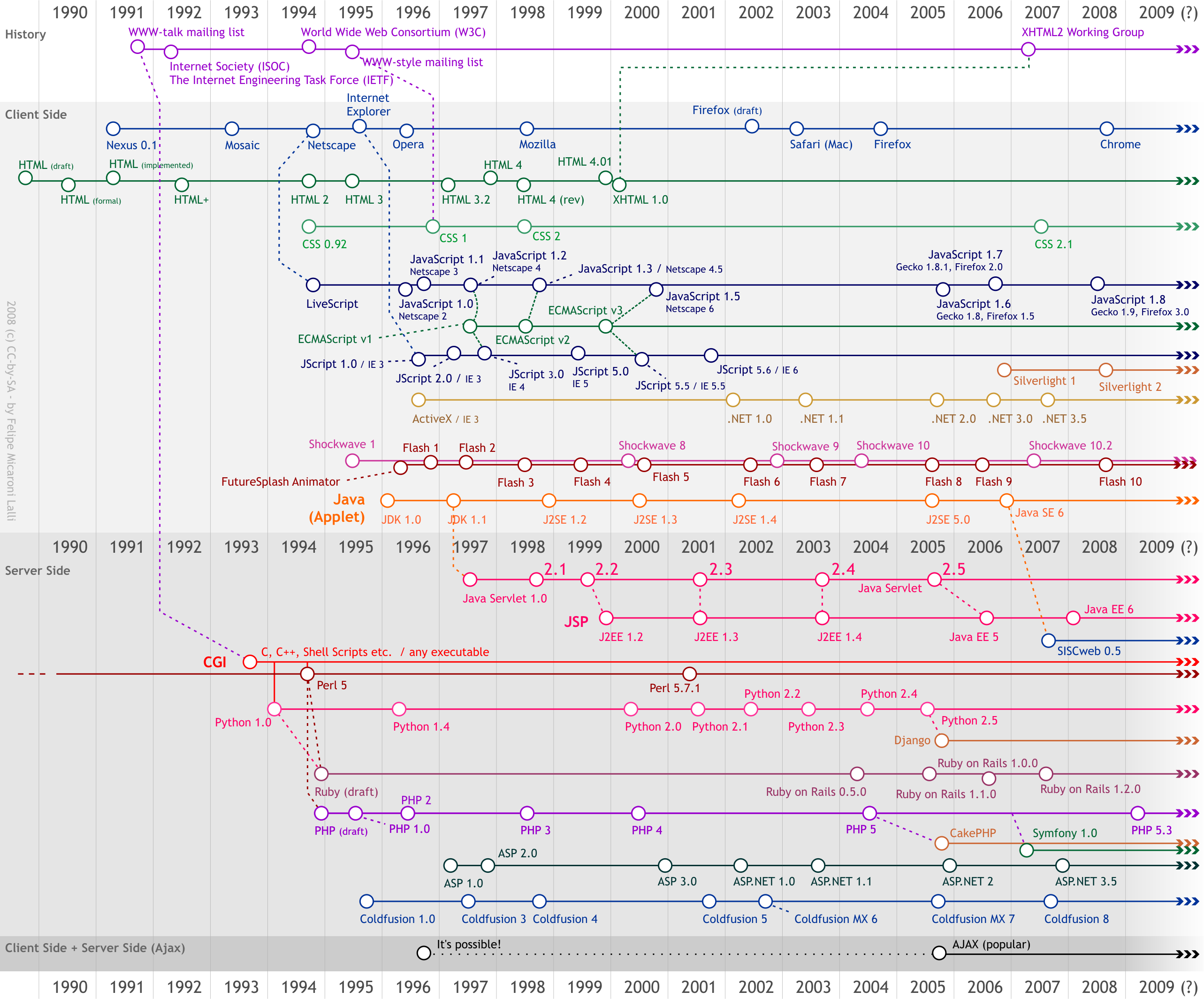
Rápida y breve historia del desarrollo en la Web


Un gráfico suele ayudar a entender un problema, particularmente las líneas de tiempo. Publicadas en Wikipedia, dos "timelines" sobre evolución de lenguajes y de browsers tienen la virtud de hacer visible el fulminante crecimiento de Internet como carril del desarrollo del software. Con trabajos precursores a finales de los ochenta, a partir de la década del 90 su crecimiento convirtió cualquier predicción sobre su evolución en hechos consumados en pocos años, retroalimentando una espiral de crecimiento que abre posibilidades apenas imaginadas quince años antes. Un impacto que promete cambiar profundamente las posibilidades de conocimiento del conjunto de la sociedad urbana.
Aquí se publica uno de ellos. El otro, se lo puede encontrar en Wikimedia.
Los artículos de Wikipedia que los sustentan son History of the web browser, y Web development.

lunes, junio 15, 2009

MoDisco: Ingeniería reversa guiada por modelos


Jean Bézivin, a quien se ha recordado aquí más de una vez, promueve y participa en un proyecto de especial interés: MoDisco ( abreviando Model Discovery), que se propone la extracción de modelos partiendo del análisis de sistemas antiguos (legacy systems). A mi juicio, este es un movimiento de importancia en el camino de avanzar hacia aplicaciones basadas en modelos: Si se examina la realidad del uso de sistemas informáticos, el panorama deja una gran heterogeneidad, un gran volúmen de sistemas obsoletos, y una débil penetración de estos conceptos, que dominan las actividades de grupos académicos y conferencias, pero que representan un porcentaje bajo del modo en que se construyen las aplicaciones en el mundo real. Si tomamos las búsquedas laborales, los ránkings de uso de lenguajes, lo que se entrevé de la vida diaria, encontramos un extenso uso de lenguajes de tercera generación, comenzando por COBOL (especialmente en España), RPG, Visual Basic, Java, C, C++...Una coexistencia de viejas aplicaciones que no se tocan porque funcionan, con modernos intentos cubriendo aspectos parciales, o viceversa, modernos paquetes preplaneados que integran antiguos desarrollos.
Por tanto, una herramienta que partiendo de lo que existe, permite crear un marco de abstracción adecuado para encauzar la construcción de software, abre posibilidades de facilitar la ampliación del uso de mejores herramientas, acortando el camino entre el desarrollo basado en modelos y las aplicaciones existentes. Como siempre se ha destacado aquí, manejar la construcción de las aplicaciones desde la abstracción de un modelo es la manera de superar esta compleja coexistencia que inevitablemente se dará en la vida real.
En fin, el objetivo de MODISCO es facilitar un puente hacia este terreno.
De la presentación del proyecto:
MoDisco (for Model Discovery) is an Eclipse-GMT project for model-driven reverse engineering. The objective is to allow practical extractions of models from legacy systems. Because of the widely different nature and technological heterogeneity of legacy systems, there are several different ways to extract models from such systems. MoDisco proposes a generic and extensible metamodel-driven approach to model discovery. A basic framework and a set of guidelines are provided to the Eclipse contributors to bring their own solutions to discover models in various kinds of legacy.
Sobre la importancia de su enfoque para hacer ingeniería reversa de antiguos sistemas, dice su presentación:

What are the benefits of the MoDisco approach compared to already existing reverse engineering tools?

First, MoDisco proposes a unified approach to model-driven reverse engineering and a metamodel driven methodology. This way, we are able to work in the modeling world, coming from a heterogeneous world to a homogeneous one. The target model engineering space already proved its adaptability and scalability by several experiments to match requirements for data integration, tools interoperability and platform migration.

Moreover, the well structured modeling world allows easy manipulation of many different concepts in a unified way. For instance, every model can be transformed, weaved, extracted with the same tool set. As those operations are defined upon models’ metamodels, they are reusable for different use cases.

Una característica (propia de Eclipse) es su característica de ser extensible, lo que deja abierta la posibilidad de adecuarlo a diferentes requerimientos a partir de su núcleo.
The MoDisco framework is a generic framework that provides a basis for extension. It offers a minimum tool set to allow model discovery. The first component is a base metamodel. It is based on the Knowledge Discovery Metamodel (KDM) from the OMG. Actually, it is a minimal subset of KDM allowing end users to define (by extension) some KDM compliant metamodels. The framework offers facilities to manipulate models which metamodels are extensions of the base metamodel.
Sobre los soportes en que se basa MODISCO:
Due to the highly diversified nature of the considered legacy, MoDisco is a collaborative project involving several organizations. Each of them will bring its own expertise in a given area. MoDisco will use as often as possible the solutions elaborated by the OMG ADM (Architecture Driven Modernization) Task Force.
(...) As a GMT project, MoDisco will make good use of other GMT projects or solutions available in the Eclipse Modeling Project (EMF, M2M, GMF, TMF, etc), and more generally of any plugin available in the Eclipse environment.
Puede consultarse su documentación en el mismo sitio.

Nota: Este artículo fue adelantado parcialmente ayer. Esta es su versión "definitiva"
Nota 2: La imágen pertenece al sitio, y es reproducida en la hoja de información rápida y en el papel de presentación.

sábado, junio 13, 2009

"En cinco años, Internet será de pago"

El 10 de junio, Barry Diller, CEO de IAC, conversa con el columnista Jon Fine, de BusinessWeek, acerca del futuro de Internet, afirmando que "absolutamente" se convertirá en un sistema de pago. La conversación fue ampliamente difundida y comentada, como una búsqueda simple en Google lo puede comprobar. Algunas opiniones favorables, y nubes de argumentaciones en contra. Evidentemente, el modelo de negocios está puesto sobre la mesa, y cada uno deberá (o deberemos) defender un punto de vista.
Caroline McCarthy en Cnet resume las palabras de Diller:
While much of the "new IAC" relies on advertising revenue, Diller declared at the conference that strictly relying on advertising as a business model is not sustainable. "I absolutely believe that the Internet is passing from its free phase into a paid system," he predicted (though, keep in mind, Diller did say he doesn't like to predict). "Inevitably, I promise you, it will be paid. Not every single thing, but everything of any value. Again, take commodity away from it."

The wealth of free content on the Internet was a matter of short-sightedness, Diller explained. In his opinion, it came out of the fear of piracy.

"People were so frightened of not being dinosaurs, and baring their heads, and not having what happened to the music industry happen to them, they just slapped everything up on the Internet for free," he said. "That's an accidental historical moment that will absolutely be corrected."

Diller doesn't believe that the poor economy will make it more difficult to get people to pay for things online. One of his subscription-based businesses, dating site Match.com, is doing very well right now: "It would not shock any of you that I think that of the things that, actually, people will do when enduring a storm, financial disaster, or otherwise, is want to hook up in one way or another with other people," Diller said.

Why is he such a believer in the triumph of paid content? Look at the iPhone, Diller told the audience, and the wild success of its App Store.

"The iPhone is a great example of what's going to happen," he pointed out. ""One of the greatest barriers to buying things is the steps that it takes, and we all know the difference when you go to Amazon and you just push your little thing and it's bought, paid for, delivered, billed, et cetera., instantly, and how much that has enabled or how much that has made the difference between just browsing and buying...that little thing, that in fact you scroll it, you do it, it comes, everything else is taken care of, is the answer to what's going to happen on the Internet when, in fact, we get the applicability of that broadly."

He acknowledged that media outlets' readership rates may drop, but that their profits will stabilize once again.

En ZDNet, Tom Steinert-Threlkeld comenta también las palabras de Diller, puntualizando cómo éste ve los mecanismos de pago:

So far, news, content and service suppliers were “afraid of not being dinosaurs and slapped everything up on the Internet for free,’’ he said, in an interchange with BusinessWeek media columnist Jon Fine.

But, that will be change. The New York Times, for instance, likely will have to go beyond the “pay wall” in order to cover the cost of its worldwide reporting corps, even if it means having 1, 2 or 3 million paid subscribers, instead of 20 million unique visitors a month. And people will pay – if it is quality they’re buying.

“People have paid for content,’’ he said. “They always have.”

IAC’s Match.com, a dating service, already charges subscription fees. IAC also operates Ask.com, the search service, UrbanSpoon, one of those iPhone apps, Citysearch, a local information service, and The Daily Beast, a content site headed by former New Yorker editor Tina Brown.

Inevitably, Diller said, the “base model” of the Internet will be paid, at the end of the chaos. The forms will include not just subscriptions and individual one-time purchases, but rapid-fire micropayments and other mechanisms.

The early examples: Amazon’s “one-click” system, where a customer enters billing address and credit card information in advance. Then, a button on the screen for a shopping cart is pressed once and the purchase or purchases associated with that cart are confirmed, billed, paid for and delivered.

Similarly, with the App Store for Apple’s iPhone handheld computing and communication devices, “the real trick and key is the billing system and the way of doing it is absolutely a blink,’’ he said.

The right billing system, broadly applied, would remove “one of the greatest bars of buying anything” which “is the steps it takes” to complete a purchase.

The entire Internet, in effect, would become an app – or content – store.

“That little thing – that in fact that you scroll it, you do it, it comes, everything else is taken care of, is the answer to what’s going to happen on the Internet, when in fact, you get the applicability of that broadly across the Internet,” Diller said. “It’s absolutely going to happen.”

And given the movement of ad and subscription revenue to the Internet, “people who manufacture that content will have no alternative,” he said.

The biggest disruptor? When broadband pipes to the Internet are connected to large screens in living rooms around the world and users are interacting with its increasingly video-based content with a remote control.

At that point, television, radio and prior media founded on scarcity, like limited spectrum whose use is overseen by governments, “will be run over by this much more open, much much less controlled (medium) that is not based on scarcity, but based on unbelievable plenty,” Diller said

Tom lleva más de trescientas respuestas; esta es una de ellas:
Saying it will become a paid system in 5 years is basically living in a delusional bubble. It has been a paid system from the start.

Everyone pays for the Internet already. We pay for the speed of the connection. Some pay email providers. Some pay for online storage. Some pay by buying products online. Some pay for rare and valuable information or to receive specific publications. We also pay with the attention we give to advertisements on our favorite sites. We pay with the time we waste sorting through all the spam we get from advertisers.

Why doesn't it surprise me that it's an old fart saying how people have always paid for content and will continue? People have always been able to listen to the radio and watch television for FREE, too. That swings both ways and means nothing.

That sort of ancient-mindset is why the recording industry is having so much trouble these days. It reeks of the mindset of control freaks from a 50's industry like the RIAA or MPAA. Start charging for or somehow limiting the content people already get for free and you will go bankrupt unless you can add enough value to justify the charges.

These days people want more from content. These days the REAL product you need to sell is improved quality of life. How will your content make my life better? How will it save me time? How will it smooth out my daily routine? Focus on that instead of how much you can squeeze out of somebody because of X bytes of your bandwidth they used.

What people might pay for is value-added and highly-targeted content available on their own schedule. If you want an example of the RIGHT way to get people to pay for a content service, look at what TIVO did for TV or NetFlix with instant Internet streaming. Even digital music purchased through iTunes is an example of how to sell content to a busy, overstressed public. Charging by the megabyte will only piss them off by giving them one more thing to count and worry about. Make it simple. Make it transparent. Make it worry free. Make our lives better. Then we'll talk.

domingo, junio 07, 2009

Para tener una guía: Historia del diseño de interface gráfica

Con poco tiempo disponible, de entre todo el material que leo y clasifico, quisiera destacar la recopilación de Gyorgy Fekete publicada en WebDesignerDepot en marzo de este año, historiando las distintas tentativas de crear una interface gráfica al sistema operativo, desde 1981 hasta hoy. A la recopilación le hubiera venido bien una fundamentación de las distintas líneas de análisis del problema, y de las corrientes principales históricas (particularmente una línea abierta para POSIX hubiera ayudado a visualizar las líneas existentes en la industria). También hubiera sido interesante presentar este recorrido gráficamente, a modo de un árbol darwiniano. Como en zoología, no todas las buenas ramas tuvieron éxito...
En mi caso, mis primeras actividades fueron sobre el Mac Os 1.0, Windows 2.0 y AIX ¿y en su caso?
El crédito del encuentro de este artículo es de André Furtado, a quien sigo en del.icio.us desde la época de su graduación en Brasil, debido a su interesante trabajo sobre software factories. No viene al caso, pero debiéramos seguir un poco más el trabajo de las universidades brasileras.

sábado, mayo 23, 2009

Plex: Webclient i+

ADC Austin anuncia este mes su release 1.4.6 de su Webclient, la alternativa que desarrollara en conjunto con Websydian, basado en modelos Plex. Para quien no conozca el producto, esta es la presentación resumida en su wiki:

WebClient is an extension to the CA Plex development environment. It allows CA Plex-developed Java GUI applications to be deployed as web applications with minimal modifications.

In order to use WebClient to deploy an application, you must:

  • Have an application that is configured for and operational as a Plex Java client/server application
  • Have a Java EE-compliant web application server
  • Build and deploy the application using the Eclipse development environment

WebClient consists of two principal components:

  • A template generator which runs during the generate and build process. For each Plex GUI panel, a file is generated which contains the HTML and Javascript code needed to display the panel as a web page. The generated templates can be customized to alter the look and feel, implement new controls, and provide additional functionality to the panels.
  • A servlet that is loaded into the Java EE application server at runtime. The servlet loads the Plex-generated Java application's class files and allows them to communication to and from the web user using the generated templates.
Crecientemente, distintos socios de CA, embarcados en extender Plex, exploran las nuevas tendencias en Model Driven Design para lograr mayor alcance, tanto para crear puentes con otras aplicaciones y paradigmas de modelo, como para abordar nuevas plataformas y arquitecturas. Este es uno de los ejemplos en curso. Cobra importancia Eclipse en este y otros proyectos.
Volveremos sobre el tema.

martes, mayo 19, 2009

Simon Williams en la reunión de Plex en Florida

Esta es una noticia de interés para quienes usan Plex. Y especialmente para quienes los que lo hacen desde la época de Synon. Simon Williams, uno de los fundadores de Synon, y el principal responsable de la creación de 2E y de Plex, volverá a hablar en una conferencia de usuarios de Plex, luego de alrededor de diez años de haber continuado con otros proyectos. Entre medio, el breve interregno de Sterling Software dió lugar a la entrada de Computer Associates (hoy CA).
Ha sido una sorpresa su participación, y un acierto de Bill Hunt el contar con Simon para la keynote. Habrá interés en escuchar su punto de vista, luego de haber seguido un camino lateral de investigación (Lazy Software), y dados la evolución producida en el desarrollo basado en modelos. Simon conoce esa evolución, y conoce el motor interior de Plex. Su visión potencialmente ofrece la virtud de unir el conocimiento de su base, y la observación de la evolución y desarrollo de las posibilidades de este concepto. Lo escucharemos.

domingo, mayo 17, 2009

Testeando el alimentador de noticias

Feedburner, que administra las entradas de este blog, ha cambiado hace algún tiempo, integrándose más con Google. Como parte de esto, la dirección de actualización de noticias ha cambiado. Si usted está suscripto, vuelva a hacerlo.
Esta nota entonces es para advertir a los suscriptores, y para testear el servicio en la nueva dirección.

jueves, mayo 14, 2009

Innovación en Iberoamérica

Con muy poco tiempo disponible, quisiera no dejar pasar dos excelentes notas relacionadas con el uso de Internet y sus mejoradas capacidades de comunicación y conocimiento, en nuestro espacio común iberoamericano. Como en otras ocasiones, los puntos en común revelan ser aquellos que nos demoran.
Una nota, de Alejandro Pisanty, sobre la posibilidad de extender a toda la sociedad mexicana el acceso a Internet. La otra, de Juan Freire, sobre el uso de las facilidades de Internet en la vida universitaria española. Invito a leerlas. Aquí, solo dos o tres líneas fundamentales de lo escrito.
De Alejandro Pisanty:
[El comentario se origina ante la pregunta de Jessica De La Portilla Montaño: para qué querría conectarse a Internet un mexicano que no contara con electricidad y otros satisfactores básicos.]

Ésta es una pregunta recurrente desde que Internet salió del ámbito académico (e incluso antes de ello) y quizás valga la pena volver sobre ella muchas veces.

La respuesta más seria a la pregunta es "no sabemos". Lo que sí sabemos es que a muchos mexicanos aislados y empobrecidos, como a muchos otros seres humanos en similares condiciones en otros países, las conexiones a Internet les han servido de mucho para contar con herramientas que permiten superar esas condiciones de miseria y marginación - incluso sin que ellos estén directamente conectados a Internet, vale decir, sin que en sus hogares haya una computadora conectada a Internet, ni hagan ellos uso de computadoras de uso compartido o colectivo en centros de población.

El beneficio llega a través de lo que por varios años ya he llamado un "intermediario efectivo": un miembro de la familia, en la mayoría de los casos joven que estudia en una escuela, que sí tiene acceso a Internet, que sí tiene una sensibilidad a las necesidades de su familia marginada y pobre, y que sí conecta las dos cosas.

Este o esta joven adquiere información de salud, o para la productividad del trabajo de la familia por rural que éste sea, o para muchos otros fines; la selecciona y procesa, y la prepara para presentarla a la familia. Ejemplos conocidos son los de jóvenes que mejoran las artes de pesca de familias huaves en Oaxaca o de cría de truchas en las montañas en Nayarit, de jóvenes que llevan cuentas de banco, auxilian en la obtención de créditos en la banca de desarrollo, auxilian en la preservación de la salud de la familia, etc.

Este "intermediario efectivo" es uno de los principales motores de la Sociedad de la Información.

Su intermediación no sólo es un transporte de información. Es exitosa por la selección de información, la presentación efectiva a quien puede usarla, y por la difusión a otros que también pueden beneficiarse.

Es decir, corresponde a una acción que transforma la cultura de la información, de la cultura tradicional que no pocas veces es - sin demérito de su efectividad - holística, tácita, y expuesta a la intervención excesiva de elementos no racionales, a otro modo de manejo de la información: desagregada, explícita, y disponible para la crítica racional.

Sobre la pregunta inicial, entonces, encontramos una respuesta al menos parcial - no se trata de elegir entre acceso a Internet y comida, acceso a Internet y empleo, acceso a Internet y medicinas, acceso a Internet y el esfuerzo colectivo y oficial de llevar la electricidad a cada casa. Éstos son falsos dilemas. Hay que sumar el acceso a Internet, y a sus beneficios, a la búsqueda de la alimentación, la salud, y el empleo, mediante la acción privada, sin duda, pero infaltablemente a través de políticas públicas e inversiones pública adecuadas.

De Juan Freire:

- Las universidades trabajan formalmente con software libre, pero en la práctica están promocionando institucionalmente sistemas cerrados, que normalmente solo están accesibles desde las redes internas o para sus usuarios. En lugar de abrir sus contenidos y enriquecerlos con la participación externa, los protegen y los condenan a la irrelevancia en un mundo que funciona ya bajo la lógica de la abundancia y de la escasez de atención y no de la lógica de la escasez y el control. Muchos profesores y estudiantes, hartos de las barreras y dificultades, acaban por llevarse sus contenidos a otros espacios más abiertos y más fáciles de utilizar.

- El profesorado que acepta el modelo que le impone su universidad sigue funcionando con una lógica de espacio cerrado y protección de contenidos y esto no hace más que agravar su desconexión de la cultura digital. Y si el profesorado está desconectado es la propia institución la que permanece al margen. En realidad, muchos profesores se enfrentan en estos momentos a una alternativa: o se desconectan, en su vida profesional, de la cultura digital o se desconectan de su propia institución. Finalmente, esta desconexión alimenta la falta de relevancia social de la universidad, un problema que crece día a día. Esta brecha no hace más que agravar un problema que ya viene de antes, pero que se acelera si tenemos en cuenta que es en estos escenarios integrados en la cultura digital en los que se están desarrollando los nuevos modelos de relación social, de innovación o de desarrollo empresarial.

- No es extraño, visto todo lo anterior, que las universidades presenten una casi nula capacidad de comunicación con el mundo exterior y, en buena medida, con sus propios estudiantes. Los ejemplos son múltiples. Es sorprendente que universidades con decenas de miles de estudiantes y situadas en ciudades de pocos centenares de miles de vecinos tengan en general tan poca presencia pública. Pensemos en organizaciones ciudadanas o empresas que con muchos menos integrantes consiguen grados de relevancia y presencia pública muy superiores.

El proceso de adaptación al Espacio Europeo nos proporciona otro excelente ejemplo. Hace unos meses El País publicaba un reportaje sobre el conflicto de Bolonia donde explicaba como mientras las instituciones educativas se comunican a través del BOE o del tablón de anuncios, los estudiantes están en los medios sociales y se organizan de modo sumamente efectivo en Tuenti o Facebook.

Lo que se está librando en los campus españoles es una desigual batalla de jóvenes que se comunican en trazos gruesos a través del correo electrónico, Tuenti y otras redes sociales, frente a unos administradores de la reforma que aún confían en el valor de una seca nota explicativa en el tablón de anuncios para difundir los cambios. En el campo de la comunicación, las instituciones están perdiendo por goleada. Y ésa es la causa de que los rectores de las universidades más afectadas hayan pedido ayuda al Gobierno.

Esta "desigual batalla" demuestra que las armas ya no son la financiación, ni tan siquiera las infraestructuras o el "poder duro". Las competencias digitales, comunicativas y sociales son ya mucho más importantes y aquí nuestras universidades llevan mucho tiempo suspendiendo y la mayoría ni siquiera se han preocupado por conocer su nota.

Discusiones que en otros ámbitos no parecen existir. Existen otras sociedades que comprenden que deben dar un salto en su desarrollo. Alejandro Y Juan ayudan a producir ese cambio.

miércoles, abril 29, 2009

Una ventana a la historia de Plex

Ramon Chen, Director de Producto de la ya desaparecida Synon, ha recreado en su sitio el original Lava Lounge, el volcánico salón de reunión de los desarrolladores interesados en Obsydian, el primitivo nombre de Plex. El corte está hecho a junio de 1998, en el momento en que se anuncia la compra de Obsydian por Sterling Software. Ramon construyó una cronología comenzando en septiembre del 96, hasta la fecha del corte.

martes, abril 21, 2009

Finalmente, Oracle toma Sun

Seguramente la compra de Sun tendrá impacto profundo en el negocio informático, y lo veremos progresivamente. Dos comentarios hoy destacan el carácter de oferta vertical que ahora podría presentar Oracle. Ashlee Vance, en The New York Times ("Cash in Hand, Technology Giants Go Shopping"), y Tom Steinert-Threlkeld, en ZDNet ("A complete industry in a box"). Vance dice:
Most consumers do not want to get a PC by purchasing microprocessors, hard drives and operating system software from different suppliers and assembling them all into a working computer. They prefer to buy a complete, customized machine from one supplier.

Corporate customers increasingly want the same thing: a one-stop shop for hardware, software and services. And the largest technology companies are deploying their huge cash hoards to make acquisitions to bolster their ability to be that single provider.

That trend drove Oracle, a leader in business software, to announce Monday that it was spending $7.4 billion to buy an ailing Sun Microsystems and get into the computer hardware business. Oracle beat out rival I.B.M., which considered buying Sun to enhance its own software offerings but ended serious acquisition talks about two weeks ago.

“Oracle will be the only company that can engineer an integrated system — applications to disk — where all the pieces fit and work together so customers do not have to do it themselves,” Oracle’s chief executive, Lawrence J. Ellison, said Monday.
Vance no piensa en lo que le pase a MySql, ni el cambio de manos de Java, sino en la consolidación de agentes con control completo del negocio. Quizá sea su punto de vista el más acertado en todo lo que comienza a debatirse tras la compra. ¿Habrá cometido IBM un error histórico?

domingo, abril 19, 2009

Indice TIOBE de popularidad de lenguajes: reaparece RPG

Ya mencionado antes aquí, mensualmente Tiobe publica un ranking de popularidad de los lenguajes de programación, que es interesante para observar tendencias. Lo puede leer estimando el futuro tecnológico, profesional, de negocios, y más, ya que los cuadros de análisis son variados a partir de la masa de datos obtenida:

The TIOBE Programming Community index gives an indication of the popularity of programming languages. The index is updated once a month. The ratings are based on the number of skilled engineers world-wide, courses and third party vendors. The popular search engines Google, MSN, Yahoo!, and YouTube are used to calculate the ratings. Observe that the TIOBE index is not about the bestmost lines of code have been written. programming language or the language in which

The index can be used to check whether your programming skills are still up to date or to make a strategic decision about what programming language should be adopted when starting to build a new software system.
La lista comparativa de abril muestra una situación estable o muy levemente descendente para los lenguajes más populares, incluyendo Java, C, C++, PHP, C# y Visual Basic, una pequeña subida para Python y Javascript, para los primeros diez puestos. Notablemente, RPG sube y se coloca en el puesto 18, creciendo fuertemente durante 2009. Mas notable todavía que la subida de ABAP en el mismo período, ya que RPG está fundamentalmente ligado al OS/400 y el ISeries (AKA AS/400). ¿Recupera posiciones el uso del AS/400?. Considerado en sí, el actual RPG tiene ya poco que ver con sus versiones iniciales, y se ha potenciado tanto como lo ha hecho el ISeries.
El ranking completo para los primeros veinte puestos:

Position
Apr 2009
Position
Apr 2008
Delta in PositionProgramming LanguageRatings
Apr 2009
Delta
Apr 2008
Status
1 1 Java 19.341% -1.55% A
2 2 C 15.472% -0.04% A
3 3 C++ 10.741% -0.06% A
4 4 PHP 9.888% -0.32% A
5 5 (Visual) Basic 9.097% -0.69% A
6 7 Python 6.080% +1.18% A
7 8 C# 4.059% +0.00% A
8 9 JavaScript 3.678% +0.75% A
9 6 Perl 3.462% -2.09% A
10 10 Ruby 2.569% -0.07% A
11 11 Delphi 2.272% +0.25% A
12 14 PL/SQL 1.086% +0.33% A
13 12 D 1.076% -0.37% A
14 13 SAS 0.792% -0.13% A
15 15 Pascal 0.717% +0.12% A-
16 21 Logo 0.707% +0.37% A
17 27 ABAP 0.658% +0.42% B
18 26 RPG (OS/400) 0.646% +0.40% B
19 19 Lua 0.491% +0.12% B
20 23 MATLAB 0.482% +0.22% B

El análisis completo se puede encontrar en la página de Tiobe. Se puede suscribir al informe mensual.
Otro aspecto de interés acerca del análisis es el análisis por categorías, con indicación de un 40% de persistencia de lenguajes procedurales:
CategoryRatings April 2009Delta April 2008
Object-Oriented Languages 55.6% +0.0%
Procedural Languages 40.3% -1.1%
Functional Languages 3.0% +0.8%
Logical Languages 1.2% +0.2%

El método de cálculo del índice es este.
Sobre Tiobe:

TIOBE is specialized in assessing and tracking the quality of software. We measure the quality of a software system by applying widely accepted coding standards and quality metrics to it.

We provide quality systems that monitor your software real-time. Software managers and architects are offered a top down view, whereas engineers get a plug-in for their programming environment to measure the quality at file level.

martes, abril 14, 2009

Un poco de criticismo sobre MS Oslo, II

Continúa la discusión entre Jean-Jacques Dubray y Douglas Purdy, con la introducción de algunas acotaciones de Charles Young. Una discusión farragosa, en la medida que se habla de algo que es un proyecto, sobre una base que a su vez se mueve. Creo que es válida la observación de Dubray, al menos aplicándola a la dirección de las investigaciones de Microsoft de los últimos años:
I am personally a bit sick of that, it seems that Oslo is taking the same path as WCF/WF and it will take years to undo quick "pragmatic" decisions made in the early days of the project. Considering that WCF was announced in 2003, shipped 2007 and being rewritten (one more time...) in 2009 for a release in 2010-2011, it looks like we should expect Oslo to do anything useful in 2014-2015 timeframe. I wish a lot more people would have the luxury to work with these kinds of time frames.
¿Será Oslo solo aplicable para la plataforma Windows? Tan pronto se desenvuelve cualquier discusión sobre el tema, éste se encauza por ese camino. En ese caso, el valor que se discute sobre la capa superior (meta-metamodelo) tendría escaso alcance.
Dubray puntualiza lo que Charles Young piensa al respecto. Todo lo dicho por Young es de mucho interés, pero particularmente sobre los objetivos de Oslo:
In this thought exercise, we are capturing models which are specific to a given technology. We need to be able to specify the metamodel very precisely in order to ensure that our models are valid and well-formed in respect to BizTalk Server. However, we will probably be less interested, in this scenario, in ensuring that our metamodels conform to some meta-metamodel. One reason for this is that we probably won’t have a compelling need to exchange BizTalk-specific metadata with other systems and applications. This could change over time, however. For example, as BizTalk Server evolves further, future versions may exhibit much closer integration with platform-level technologies such as WCF and WF, or standards such as BPEL4WS and BPMN. They may be more deeply integrated into platform-level host environments (this is already the case with regard to IIS-based ‘isolated’ hosts in BizTlk Server). In this case, the ability to exchange and transform metadata on the basis of some meta-metamodel could become an important consideration. Even here, though, we might wish to our meta-metamodelling to address a specific technology platform.

A major theme in Oslo is the reduction of the bar that ISVs and development teams face when seeking to support rich modelling approaches to software development and runtime configuration. Oslo is agnostic with regards to the number of metalayers that are required in any given scenario and makes no assumptions with regard to how platform/technology-specific or independent a particular model needs to be. It avoids forcing conformance to any abstract M3 specification and provides a general-purpose metamodelling language that minimises the learning curve for developers. To all this, Microsoft adds pre-defined mappings to T-SQL and is building additional tooling for generalised visualisation of models and parser generation tools for creating domain-specific modelling languages. They also provide many pre-defined models (e.g., for WF workflows) out of the box.

In our BizTalk Server example, the bar is now set very low. MSchema is a natural choice for defining model specifications whose conformance to the models in the BizTalk management database can be verified, but which can reduce the amount of detail to an appropriate level. The Oslo tooling can be used to create tables in the repository which correspond directly to the tables in the Management database. Access to models in the repository can be via any appropriate and familiar data access technology that can connect to SQL Server. There is no need for developers to engage in a steep learning curve in respect to meta-metamodelling, no need to conform to unfamiliar APIs and no need to inject an unnecessary level of platform independence in the way models are specified.
Charles Young historia las relaciones entre Microsoft y la OMG (UML, metamodels, MOF and MDA), hasta desembocar en las Software Factories y Oslo. Pero eso podría verse por separado. Curiosamente, esta historia de interrelaciones es prácticamente inhallable hoy.

jueves, abril 09, 2009

Un poco de criticismo sobre MS Oslo

Jean-Jacques Dubray escribe en su blog acerca de Oslo (Where is Oslo going?), reflejando un poco de descreimiento en el curso definitivo que el proyecto tome. Pero además, Jean-Jacques hace algunas agudas observaciones sobre arquitectura y el futuro del modelado.
En primer lugar, sus observaciones sobre Oslo:
What is clear is that now Oslo is only about "modeling", SOA and Composite Applications are simply areas where Oslo can be applied. That's a bit different from the original announcement on the project in the fall of 2007 and pieces like "Dublin" seem to have fallen off Oslo which is now only 3 elements: a metadata repository, quadrant and the M language.
Dubray parte de una premisa con la cual juzga Oslo:Metamodel Oriented Programming (MOP):
MOP is an approach which seeks to create a programming model independent of architecture such that architects can architect and developers can build the solution in an architecture independent way. This is in line with projects like Microsoft Volta which talked about "Architecture Refactoring" concepts. Incidentally Volta has disappeared from the face of the earth, what a shame. MOP is not about creating a single programming model, but again, rather an approach to separate architecture(s) from programming model(s). I, of course, focus on SOA and Composite Apps, but as a good software engineer, I believe that anything I do is so general MOP can be applied to anything...
Dubray, basado en las conjeturas que permite extraer la todavía difusa información sobre Oslo, sostiene que el proyecto no logra establecer una separación clara entre el nivel de abstracción de modelado y la programación:
If you build something like Oslo you start with a programming model like .Net RIA Services or anything you want that tries to do the same thing and then you build Oslo to make it easy(ier) to build something like .Net RIA Services. In case you have not noticed MOP has already happened, all the annotations in Java or C# is MOP layered on top of OO. But MOP layered on top of OO does not provide a clean separation between Architecture and Programming Models. This is the mission that Oslo should set itself up with. So starting with an "app" is, of course, a traditional Microsoft approach. But this is the wrong level. This is actually catastrophic to start at this level, it ensures they will never deliver something at the MOP level. What our industry needs today is not a better way to write code snippets or string templates, it needs a way to express business logic in a sustainable way, i.e. outside a given architecture.
Sobre M:
"M lets developers build out domain-specific languages (DSLs) relatively easily" is no longer the problem, Microsoft has DSL tools for that, the question that the Oslo team should ask itself is does M stands for Model or Metamodel?
Douglas Purdy, mencionado por Dubray, acaba de contestarle. En todo caso, postula M como una herramienta para trabajar a nivel de metamodelos y meta-metamodelos. Diferenciando M de las DSL tools de VS:
The current DSL tools (the DSL Toolkit) are for visual DSLs, not for textual DSLs. We want an architecture that supports both both textual and visual DSLs operating over the same model. Speaking of model, M is for model and metamodel and metametamodel. Since my Smalltalk days, I have grown tired of using the meta prefix, as it often confuses more than helps the conversation with developers.
También en su contestación está implícito el rumbo zigzagueante de Oslo desde su inicio al contestar aceerca de la relación entre Oslo y FTA.

Está abierta una discusión...Más allá del punto de vista sobre Oslo, otras aristas del pensamiento de Dubray merecen ser seguidas. En otro momento.

miércoles, abril 01, 2009

Un tercer aspecto de la (posible) venta de Sun

Eugene Ciurana, en un post en The Sever Side, agrega un factor más a las razones de la compra de Sun, ahora apuntando a su (eventual) estrategia futura para Java. Según especulaciones de Stephen Colebourne, Sun perseguiría retornar Java a un desarrollo propietario:
Stephen Colebourne argues that there will be no Java 7 because of the ongoing disagreements between the Apache Software Foundation, Sun, and the JCP regarding Apache Harmony, the independent, open source, compatible Java SDK.

Stephen argues that Harmony's success motivated Sun to return to a proprietary Java development model and is blocking Harmony from getting the JDK compatibility kits it needs for validating that its Java implementation is up to snuff.
[Según Stephen Colebourne] Apache's implementation of the Java SE 5 JSR specification is Apache Harmony. However, when Apache came to obtain the testing kit for the specification a whole political game started. Instead of Sun offering the testing kit as normal for each of the other 25 JSRs, they offered a testing kit where the results of the tested code would not be Open Source

Obviously, Apache couldn't accept this limitation, which is against the legal agreement signed between Sun and Apache. Apache complained 2 years ago, but has yet to receive an acceptable response. And no, there is no way a charity not-for-profit like Apache is going to sue a multi-national corporation - who do you think would get the better lawyers?

The key point is that Sun's tactics here were quite deliberate. They knew exactly what they were doing by offering a testing kit with a restrictive license. They wanted to ensure that Apache Harmony couldn't be certified as complete. Sun was going out of its way to ensure that there was no competition to its own JDK.

In the meantime, Sun played the OpenJDK card. It announced the release of the JDK under the GPL license [...] I think this shows a gross lack of perspective - the code may now be GPL open source, but the specification is now no longer open. Which is more important?

Thus, the next release will be JDK 7, not Java 7.

This means that there won't be an open Java 7 specification. This would mean that what makes it into Java is what Sun choses to release in OpenJDK, not what's agreed in the JSRs. This returns control of Java back to Sun and prevents its standardization.

Stephen made a second posting where he documents the ongoing discussions between the Apache Harmony and Sun regarding the Java 7 specifications, using the JCP Executive Committee meeting minutes to support his argument.
An interesting read, to say the least, and a potential threat to having an open Java specification.


¿Qué peso puede tener esta hipótesis? En este caso es simple: el tiempo le dará su lugar en pocos meses.

martes, marzo 31, 2009

Una nueva versión sobre la (posible) venta de Sun

Gavin Clarke, en The Register, agrega otra faceta a la ronda por el futuro de Sun: la propuesta de compra de IBM habría bloqueado una compra de Sun por parte de Oracle y Hewlett-Packard, desmembrada en dos negocios: la cartera de software para Oracle, y el hardware para HP. El negocio representaba "más de 2000 millones de dólares". La oferta de IBM por más del doble habría congelado la operación:
Oracle and Hewlett-Packard are believed to have made a joint offer for Sun Microsystems in a deal totaling more than $2bn.
Under the deal, database giant Oracle would have taken Sun's software portfolio for $2bn, leaving HP with Sun's vast Solaris, Sparc, and x86 server products, manufacturing and distribution, and user base.
A potential deal between the three is understood to have been blocked by IBM, in the middle of talks to buy the whole of Sun for a reported $6.5bn.
Oracle, HP, and Sun declined to comment on what they called rumors, while IBM was unavailable for comment at the time of going to press.
A source, who didn't want to be identified, told The Reg that Oracle and HP had gone in to meet Sun to discuss the possible deal.
It's already been reported that Sun had been shopping itself around Silicon Valley, with HP named as a potential buyer.
This, though, is the first indication that HP had teamed with Larry Ellison's M&A beast Oracle - which has bought 50 companies in four years - to take only what they wanted from Sun. At $2bn, this would have been one of Oracle's large purchases, slotting behind PeopleSoft and BEA Systems.
Oracle and Sun parted ways on Java and on databases on Sparc a while back, partly thanks to Sun's $1bn purchase of the popular open-source database MySQL.
Of all Sun's software products, Oracle is likely to be most interested in owning this.
Lo que está claro, es lo oscuro del futuro de Sun. En épocas difíciles, las estrategias de negocios están bajo fuego.

sábado, marzo 28, 2009

La posible adquisición de SUN

James Gossiling opina sobre la eventual compra de Sun por IBM; recogido por Jason Stamper, en Computer Business Review:

Gosling insisted the rumoured acquisition is, “Obviously just speculation at this point.”

But asked about the different cultures within IBM and Sun, and in particular their developer staff, Gosling said: “There would definitely be a culture clash. We’re definitely weirder than they are.”

“We grew up from a bunch of hippies, almost with flowers in our hair,” said Gosling.

Although the firm was founded in 1982, its proposition, which involved the peddling of open systems in general and Unix in particular -- and more recently its transition into a major contributor to the open source software movement – has given it a certain hippy, perhaps even radical culture. Especially when compared to the more proprietary computing platforms that preceded it, IBM included.

But Gosling suggested that it would still be possible for Sun and IBM staff to settle their differences: “We’re a much more grown-up company now [than when Sun was founded] with a very different group of people. We’ve become a full-on enterprise software company,” he told CBR.

Asked whether it would be interesting to try and in some way combine some of Sun’s NetBeans open source development framework technology with IBM’s rival Eclipse project, Gosling said: “It would certainly be possible. We have been partners on the Java journey for quite a few years. In many ways there would not be a huge impact on Java development.”

But in a statement that perhaps has ramifications for IBM’s rumoured acquisition of Sun, Gosling – the inventor of Java – said that the Java community is now, “Such a large community of people that nobody could control it. If anybody tried, it would ruin it all.”

Desde hace tiempo, ambas empresas tienen más puntos en común que diferencias en su orientación a Open Source. Una eventual absorción probablemente favorecería la actividad en Eclipse. Y quizá por el lado de IBM ampliaría su soporte a Java, creciente sobre sus equipos de rango medio (ISeries). Sin embargo, una compra tiende más a ser la absorción y eliminación de un competidor en el mercado. Dana Gardner, en ZD Net, duda de su viabilidad y realidad:

By buying Sun IBM gains little other than some intellectual property and mySQL. IBM could have bought mySQL or open sourced DB2 or a subset of DB2 any time, if it wanted to go that route. IBM has basically already played its open source hand, which it did masterfully at just the right time. Sun, on the other hand, played (or forced) its open source hand poorly, and at the wrong time. What’s the value to Sun for having “gone open source”? Zip. Owning Java is not a business model, or not enough of one to help Sun meaningfully.

So, does IBM need chip architectures from Sun? Nope, has their own. Access to markets from Sun’s long-underperforming sales force? Nope. Unix? IBM has one. Linux? IBM was there first. Engineering skills? Nope. Storage technology? Nope. Head-start on cloud implementations? Nope. Java license access or synergy? Nope, too late. Sun’s deep and wide professional services presence worldwide? Nope. Ha!

Let’s see … hardware, software, technology, sales, cloud, labor, market reach … none makes sense for IBM to buy Sun — at any price. IBM does just fine by continuing to watch the sun set on Sun. Same for Oracle, SAP, Microsoft, HP.

With due respect to Larry Dignan on ZDNet, none of his reasons add up in dollars and cents. No way. Sun has fallen too far over the years for these rationales to stand up. UPDATE: Tony Baer likes Fujitsu as Sun savior.

Only in playing some offense via data center product consolidation against HP and Dell would buying Sun help IBM. And the math doesn’t add up there. The cost of getting Sun is more than the benefits of taking money from enterprise accounts from others. [Disclosure: HP is a sponsor of BriefingsDirect podcasts.]

Eric Newcomer pone el acento en la competencia por el liderazgo de la comunidad Java, y sí considera que existe interés de parte de IBM en la compra, particularmente si futuros desarrollos de Sun siguieran un camino distinto del que hoy otras empresas tienen embarcado:

The hot topic of debate today is the breaking news story that IBM is in talks to acquire Sun. Dana Gardner doubts this, and a bunch of myFB and Twitter friends ask the obvious questions in their status updates: Why the heck would IBM want to do this?

I haven’t seen anyone yet bring up the Java question. As co-chair of the OSGi EEG and formerly 9-year employee of a Java vendor, I have seen the battles between Sun and IBM over the control of the Java langauge up close. It has never been a pretty picture.

Recently I was asked about Jonathan Schwartz’s blog entries about Sun’s future direction and corporate strategy. The content of these entries has been subject to the usual praise and criticism, but I haven’t seen anyone talk about what’s so obviously and painfully missing - at least for someone active in the Java community and trying to push the ball forward (e.g. enterprise OSGi). Where is the talk about leading the Java community? Where is the talk about collaboration with IBM, Oracle, Progress, Tibco, and others? Where is the description of how helpful Sun is toward Apache’s Java projects (especially Harmony)?

IBM has ported many products onto the OSGi framework during the past several years, including flagship products such as WebSphere Application Server and Lotus Notes. Never mind the fragmentation in the Java community caused by the disagreement over SCA. What about Sun’s recent announcement that they were going to reinvent Java modularity in the Open JDK project, all on their own, without input, without regard to what happens to OSGi? What kind of potential change cost does that represent to IBM and all the other Java vendors who have ported products onto OSGi?

The potential acquisition of Sun has been debated so far mostly in terms of the business value Sun has - that is, in the context of where it is still making money, as if that were the main or only reason for an acquisition. But I say again, what about the unrealized potential for collaborative leadership in the Java community? Sun obviously isn’t paying attention to this, but IBM might be.

Para más información, la eventual compra, analizada por The Wall Street Journal.